
Farm & Ranch
[AgriLife Today] Texas crop and weather report for March 15, 2016

By: Adam Russell
Back to normal, spring crops on track after prior years of drought and flooding
COLLEGE STATION – Producers around the state are finding conditions more favorable for planting early crops compared to last year, according to Texas A&M AgriLife Extension Service reports.
Dr. Ronnie Schnell, AgriLife Extension agronomist in College Station, said corn and sorghum producers are on or a little ahead of schedule with plantings as soil conditions appear to be favorable because of winter moisture and timely spring rains. Fields in the Brazos Valley are in much better condition than last year, when torrential rains delayed plantings for months in some cases.
Schnell said some farmers started early to avoid possible delays. He said some corn is already emerging in the region.
“There was good winter moisture and a dry out that gave them the ability to get into their fields to plant before these recent rains,” he said. “I don’t think everyone was finished but there was a lot of activity and I think a lot of the fields are planted.”
Dr. Gaylon Morgan, AgriLife Extension agronomist in College Station, said cotton fields in the Rio Grande Valley were 80 percent planted and overall there have been few delays up to this point. Morgan said mild winter conditions spurred farmers to plant rather than risk rain delays.
“Most producers in the (Rio Grande) Valley planted earlier than usual because they were gun-shy after what happened last year when it was wet and stayed wet,” he said. “They wanted to get it in.”
Morgan said moisture levels were looking good around the state and that 2016 has been a return to normal so far — compared to prior years of drought and flood. He said soil in some areas would be full of moisture 2-4 feet deep, which would be beneficial to rooting plants between rains.
The rains were helpful to many areas and crops, but the precipitation and subsequent humidity is causing problems for wheat fields around the state, said Dr. Clark Neely, AgriLife Extension specialist in College Station. Wheat rust has been reported around the state, and recent rains and overall humidity levels could provide ideal conditions for the disease.
“There’s a lot of rust being reported and rain only helps facilitate the disease’s development,” he said. “The reports we’ve seen in January and February are indicative of a bad rust year.”
Warmer- than-usual temperatures put wheat two weeks ahead of schedule and have producers concerned about possible freezes that could damage fields. There were 5.3 million acres of wheat compared to 6 million acres planted last year, a 12 percent decrease.
Despite concerns, Neely said overall the wheat crop is in good shape. Most of the state’s production is concentrated in the Rolling Plains and High Plains areas, which benefitted from the recent rains, he said.
“All these rains that might have hurt us helped them,” he said.
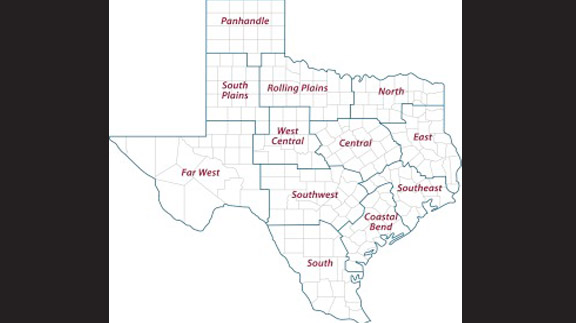
AgriLife Extension district reporters compiled the following summaries:
CENTRAL: Counties in central Texas reported severe storms and 6-8 inches of rain over five days. All counties reported good soil moisture. Overall range and pasture conditions were reported as good while overall crop conditions were fair. Pastures were greening up and conditions were improving but supplemental feeding was still necessary for livestock. Cattle remained in good condition for most of the area. Small grains were looking good. While corn has been planted, some of those fields were drowned out by rains. The rain also stopped work in some fields for a few days. Fruit trees have bloomed. Tanks were full and rivers and creeks were running.
ROLLING PLAINS: Heavy rains fell across parts of the Rolling Plains. Five inches to 7 inches of rainfall resulted in some dangerous flooding. However, there was no report of missing livestock and stocker cattle were doing well. Lakes and ponds were full. Higher-than-normal humidity contributed to more disease issues in wheat. Some producers treated wheat rust. Others were trying to hold out as long as they could or were trying to figure yield potential and the economic feasibility of rust application.
COASTAL BEND: The reporting area received from 1.5-7 inches of rain, which provided a good boost to the soil moisture profile. But wet conditions were expected to slow agriculture activity. Temperatures remained higher than normal. Sorghum and cotton planting were expected to resume after fields dried. Corn planting was almost complete. Some replanting may be necessary in flooded fields. Rice planting made a comeback due to water availability from the Colorado River. Rice acreage was predicted to be close to pre-drought levels. Some fertilizer was being spread on warm season pastures and hay fields. Cattle were in good condition and continued to transition from supplemental feed to spring pastures.
EAST: Flood conditions existed after up to 20 inches of rain fell throughout the region. Many counties that reported dry conditions last week reported surplus moisture with creeks, ponds, and lakes overflowing. Pasture and range were mostly in fair condition. Most counties reported surplus subsoil and topsoil conditions. Cattle were being moved out of bottomland in Henderson County. Some producers had trouble getting into their pastures. Some gardeners reported losses of early planted crops. The Shelby County judge ordered a mandatory evacuation for residents living along the Sabine River and the Toledo Bend reservoir. Confirmed tornadoes were reported in Henderson County and caused major damage. Livestock were doing fair to good with supplemental feeding. Cows were calving and gaining weight. Livestock markets seemed to be more stable. Most classes of feeder heifers and steers ended steady. Slaughter cows were up and bulls were firm. Spring cattle work began. Bull turn-out was underway for spring calving herds. Feral hogs were causing problems. There were reports of hog hunter dogs contracting pseudorabies. Pollen from pine trees started to fall.
SOUTH PLAINS: In Cochran County, soil continued to dry out due to lack of moisture. Pasture and rangeland needed rain as producers continued to prepare for spring planting. Winter wheat would benefit from rain but continued to mature. Floyd County producers received three-quarters of an inch of rain, which helped winter wheat and provided good moisture to start planting next month. Wheat looked very good. Light rainfall was received in portions of Garza County, with amounts ranging from a quarter inch to half an inch. Producers continued to prepare land for cotton planting in the coming months. Most ranges and pastures were in fair to good condition, as warm season grasses were beginning to come out and beginning to grow in low-lying areas. Cattle concentrated on those areas and followed new growth. Cattle were in mostly fair to good condition with little-to-no supplemental feeding at this time. Rainfall was needed in most areas to fill the topsoil profile as subsoil moisture in pastures remained good. Lubbock County received needed rainfall this week, but it was spotty. Amounts ranged from a few hundredths of an inch to more than 1 inch. Land preparation continued, including application of fertilizer and herbicides and listing rows. Spot checks of several wheat fields indicated growth nearing the jointing stage. Scurry County producers received trace amounts of rain but more rain was needed. There was no precipitation reported in Yoakum County. Irrigated fields of winter wheat and oats continued to look good. Calm winds allowed grape growers to spray.
PANHANDLE: Temperatures were warm, dry and windy for most of the week. Some moisture was received. A good rain was still needed throughout the region. Collingsworth County received rain early in the week. Cooler temperatures and cloudy skies provided some good moisture. Wheat and pastureland was greening up due to heavy morning dew and high humidity. Spring round-up was beginning. Deaf Smith County producers continued field preparations for the coming planting season. Compost and fertilizer trucks were running as quickly as possible in preparation for planting season. The winter wheat crop was holding on and many producers started pivot irrigation on their wheat crops. Dryland crops were suffering from lack of moisture. The wheat crop was growing fast with much of the wheat breaking dormancy and needing moisture to continue its growth. Stocker cattle were still running on wheat pasture with more being added to graze the pastures out. Scattered showers were received across Wheeler County. Some areas received up to half an inch but more was needed for wheat. Pastures began to green up. Weeping lovegrass was growing and producers began to fertilize. Cattle were in good condition. Range and pastures was rated mostly fair to good.
NORTH: Rainfall amounts varied from about 1.5-3.5 inches around North Texas. Topsoil moisture varied from adequate to surplus. Bottomlands were flooded. Milder-than-usual temperatures were reported. Rains put a halt to corn planting; it was estimated up to 15 percent of the total corn acres were planted before the rains began. Cattle producers pulled cattle off winter annual pastures again because soils became saturated. Wheat looked better after two weeks of sunshine and warmer weather before the rains came. Signs of stripe rust have been reported in several fields and could be a problem this spring in most areas. Producers were debating on when and what to spray if they plan to harvest. Some producers said they would be better off grazing out the wheat. Winter grasses and legumes on range and pastures had ample moisture and could really come on with a forecast of warm weather and sunshine between possible rain on Wednesday and Friday. Bermuda grass and other warm-season grasses were beginning to green up earlier than normal due to the mild winter. Most producers hoped to avoid a repeat of last year’s spring flooding that caused low yields and complete failures of wheat, oat, milo and corn crops. There was very little greenbug activity so far.
FAR WEST: Culberson County received a trace of precipitation with very windy conditions finishing out the week. Glasscock County received up to half an inch of rain. Leaf and stripe rust was building in area wheat crops. Fields have been sprayed and more were set to be sprayed when weather permitted. Farmers continued to prepare fields for corn and sorghum planting. Pastures were starting to green and mesquite trees were close to breaking bud. Presidio County had cooler temperatures with nighttime temperatures below freezing. The week ended with very windy conditions and high fire danger. Bulls were out with cows and most calving was complete. Pastures were greening up. Portions of Ward County received up to a quarter inch of rainfall early in the week. Areas that received precipitation were showing response from annual weeds. Calving continued along with supplemental feeding. Upton County received some much-needed moisture. Farmers continued to prepare fields for this year’s crops. Livestock continued to kid and lamb out. Supplemental feeding of livestock and wildlife continued. Pecos County received a third of an inch of rain and mesquite trees were putting on leaves. Pasture and range conditions were poor. Winter wheat was fair. Subsoil and topsoil moisture was short.
WEST CENTRAL: Days were very mild with cool nights. Widespread rainfall was reported throughout the week in almost all counties. The rains should help boost spring grasses, non-grasses and winter wheat crops as well as improve soil moisture for spring planting. Field preparations for spring planting were underway but could be delayed until fields dry out. Winter wheat was in mostly good condition. Some wheat rust was reported. Range and pasture conditions continued to improve with green-up and growth. Warm season grasses and non-grasses were beginning to break dormancy in many areas. Fruit trees were beginning to bloom. Texas winter grasses continued good growth and winter wheat was being grazed by livestock as supplemental feeding continued. Livestock remained in fair to good condition, and cattle prices continued to hold steady. Some area lakes and ponds caught a significant amount of runoff. Rains also reduced range fire conditions tremendously.
SOUTHEAST: In Brazos County, the majority of corn had been planted. Significant rainfall across the county caused some flooding in low areas. In Grimes County, recent flooding replenished the soil moisture content but reduced the amount of days suitable to work in the field. Hardin County experienced historical flooding. In Montgomery County, rains were spread over the week, so flooding was minimal. Most areas in the county received 3 inches of rain with some areas receiving more than 7 inches. Brazoria County experienced three days of heavy rain but did not report measurements. More than 6 inches of rain fell in Chambers County. Some rice was being planted before the rain came. It could be a week before field work can resume. Fort Bend County received 3 inches of rain. Approximately 95 percent of corn, 85 percent of grain sorghum and 5 percent of cotton has been planted. Livestock were in good condition. Galveston County experienced very heavy rain for several days, which resulted in flooding and standing water in areas throughout the county. Soil-moisture levels throughout the region varied widely, mostly in the adequate to surplus range with surplus being the most common. Brazos, Galveston, Hardin, Montgomery and San Jacinto counties reported 100 percent moisture surplus. Rangeland and pasture ratings varied widely, with most rating from fair to very poor. Good ratings were most common. San Jacinto County reported 100 percent good pasture ratings. Hardin County reported 100 percent of pastures as very poor.
SOUTHWEST: Areas in the southwest received 2-4 inches of rain, which was great for spring planting. Peaches were in bloom and seemed to have received enough cooler temperatures as well. There were reports of rapidly increased weed growth as spring approaches. Cool temperatures after the rain followed by warmer temperatures increased spring growth of grass and forage. Livestock were in fair condition as lambing and kidding continued.
SOUTH: Rainfall was received throughout the region this past week, which improved soil moisture, range and pasture conditions and crop production. Temperatures were mild throughout the Frio County area. Wheat crops continued to develop, but there was some fungicide spraying to address rust. Potato and corn crops also continued to develop and were in good condition. La Salle County received about an inch of rain. Range and pastures continued to improve throughout the northern portions of the region. Soil moisture conditions were 100 percent adequate in the Frio County area and 80 percent adequate in the La Salle County area. The Brooks County area received rain after two months of dry conditions. An estimated 3 inches of rain fell in some areas and as much as 4.5 inches fell in other areas of the county. Farmers were watching forecasts and fertilized their fields before the rain. Soil moisture conditions were 100 percent adequate. Some much-needed rain fell in Jim Wells County. Most areas received up to 2 inches of rainfall from a strong storm system that moved northward along the coast. The moisture should ensure a good start to the crop-growing season in the Jim Wells County area. Soil moisture was 50 percent to 100 percent adequate. Crop producers can begin to plant crops in the weeks to come if all goes well. Kleberg and Kenedy counties averaged 5 inches over a 24-hour period. More rainfall was expected. Range and pastures will benefit greatly from the rainfall received but increased weed and pest problems were expected. Sorghum planting continued. Soil moisture was 70 percent adequate in the Kleberg and Kenedy counties area. To the west, favorable conditions continued in Dimmit County, which received significant rainfall. But additional rain was needed for range and pasture improvement. Around 4 inches of rain fell in Webb County and temperatures were cooler. Soil was 60 percent to 80 percent adequate in Dimmit County and 60 percent adequate in Webb County. A measureable amount of rain fell in Zapata County. Three inches of rain was reported in some areas. The soil was saturated in those areas. The rain was the first reported in more than two months. Some runoff occurred throughout the area. Soil was reportedly 50 percent to 60 percent adequate in Zapata County. Temperatures were hot and sticky before the storms and cool thereafter. Rain fell in Zavala County throughout the week and limited field activities to almost nothing. Producers reported weather conditions allowed them to do maintenance and repairs on equipment, since fields were too wet to do any other field tasks, including cultivation, planting and harvesting. A 100 percent surplus of moisture was reported in Zavala County. Livestock producers, with livestock on both native range and pastures or planted winter grazing pastures, were happy to receive rain. Overall, producers remained in a wait-and-see mode to assess the effects of timely rains on agriculture production. Widespread rain fell in the south and should benefit most agriculture production. Harvesting of sugarcane, citrus and vegetables was temporarily interrupted due to wet fields. Row-crop planting of grain sorghum and cotton was also slowed or halted throughout the area. Starr County received scattered showers. Between 2.5-5.5 inches were received throughout the county. Range pastures and recently planted row crop fields should benefit from the rainfall. Soil moisture conditions were 80 percent adequate in the Hidalgo County area and 90 percent adequate in the Starr County area.
-30-
LikeTweet
Find more stories, photos, videos and audio at http://today.agrilife.org

By Tony Dean
Farmers and ranchers are in a very close partnership with Mother Nature. If we really pay attention, she presents us some interesting scenarios.
For example, though they are totally different types of plants, water lilies and prickly pear have a lot in common. They both have strikingly beautiful flowers, both plants are edible, both of them are invaders into their respective habitats, and too much of either one can be an obstacle that we have to deal with.
Many north Texas ranches rely on excavated ponds for livestock water. Any time a pond contains a significant amount of shallow water so that sunlight reaches the bottom, some type of pond weed will develop. The plant family that includes water lilies and lotuses is a common invader in our livestock water.
Water lilies and lotuses are in the same plant family but they are two separate genera. There are easy ways to tell them apart:
- A primary difference is that water lily leaves commonly float on the surface, but lotus leaves can grow above the water line.
- Water lily leaves and flowers are thick and waxy, while lotus leaves and flowers are thin and papery.
- Water lily leaves have a distinct notch in the leaf, while lotus leaves are more rounded.
- Water lily flower petals are pointed, and lotus petals are more rounded.
The photos attached to this writing are from Clay County, and this plant is common across north Texas. American lotus is adapted to a wide area, from Honduras north through Mexico and across the eastern US and into Canada.
American lotus is a perennial, and it is cold tolerant and heat tolerant. It can grow in any pond or slow moving stream that contains shallow water areas. It prefers water with a depth of about 12 inches. Germination can occur from the large lotus seeds. Tubers, or roots, are established in the mud, and long slender stems extend upward. Leaves and flowers are both emergent in that they grow above the water line.
Lotus flowers are fragrant, and yellowish white with rich gold centers. They open in the morning and close by late afternoon, then open again the next day.
Lotus is an edible plant and has a history as a food source. The large tuberous roots, the size of a human arm, were baked like sweet potatoes. The leaves were eaten like spinach, and the large seeds were ground into flour. Stems taste somewhat like beets and were usually peeled before being eaten.
There is a large world-wide industry of cultivating lilies and lotuses in water gardens. According to Dr. Jerry Parsons, Professor and Extension Horticulturist with Texas A&M AgriLife Extension, cultivation of these plants dates back as early as ancient Egypt. Today, anyone with determination and a little money can have a water garden.
In 2011, the 82nd Texas Legislature designated the water lily “Texas Dawn” as the official Texas State Water Lily. Texas Dawn is a hybrid developed by Texas resident Kenneth Landon, a world-renowned expert in the field of water lilies and the director of the International Water Lily collection in San Angelo.
Ducks and other wildlife utilize the large acorn like seeds of American lotus, and submerged portions of all aquatic plants provide some form of wetland habitat. Many of us have tried to pull a bass out of a group of water lilies or lotuses, and I’m sure others have had better luck than I did. Although there can certainly be benefits to lilies, lotuses, and other aquatic plants, they can also infest ponds to the extent that the pond is not functioning correctly.
So, while the rest of the world works hard to grow these plants, ranchers sometimes need to control populations in their stock ponds. Once it gets a foot hold, American lotus can spread aggressively in wetland areas.
The primary issue that encourages American lotus, and most other water weeds, is shallow water. Look closely at a good livestock pond and you will find that the deeper water is basically free of infestation. Any pond will have a certain amount of shallow water that encourages water weed growth, depending upon the terrain at the pond site and how the pond was constructed. Some ranchers who enjoy and utilize wetland habitat may prefer to have ponds with significant shallow water area.
Almost all livestock ponds have a certain life expectancy. Siltation, or movement of soil into the pond bottom through rainfall runoff, is a natural occurrence. How fast siltation occurs into each pond, and how deep the pond was to start with, determines the length of time that the pond will contain adequate depth for dependable water for livestock.
Ponds that develop infestations of water weeds over a large percent of the surface may not have adequate depth to remain a viable water source for livestock during drought periods, especially in western north Texas where evaporation rates are higher.
Mud, or silt, from the pond bottom, can be removed to deepen the water, but this is a very expensive process. It is often more economical to construct a new pond rather than try to remove the silt from an old one. Most of us do not have the funds to continually construct deep water livestock ponds, so we must try to keep existing structures functioning and providing good drinking water for livestock, for as long as we can. Control of pond weeds like American lotus may be necessary, and it can be accomplished.
There is currently no feasible biological control. American lotus can be cut and removed, but this process us usually temporary because lotus can reestablish from seeds and roots.
American lotus can be safely controlled by chemicals. This must be done carefully. If a pond containing a large amount of any pond weeds is treated to remove all of the vegetation, a fish die-off could occur. When the dying weeds decompose, they use up the oxygen in the water and fish can suffocate. If possible, treat only a portion of the area, wait about two weeks, and treat another portion.

This morning, I walked out into my arena and noticed something that gave me pause. The roping steers had been in there the day before, and even though the ground was wide and level, the sand carried their story. Hoofprints crossed every direction, but in several spots, the same trail was pressed deeper than the rest. Twelve steers had been turned out, yet more than a few chose the exact same path, wearing it down until it stood out from all the other tracks.
Cattle are creatures of habit. Anyone who has spent time around them knows this. They like routine: the same feed, the same water trough, the same shade tree in the pasture. When they are turned loose, they rarely wander without purpose. More often than not, they move together, following the same course as the steer in front of them. There are reasons for this: efficiency, safety, instinct. Walking a beaten path conserves energy, and following the herd is their natural defense. Even in an arena with no real destination, those instincts come through. By the end of a short turnout, you will see the evidence, lines where they have chosen the easiest way to travel and stuck with it.
Out on the range, those lines last longer. Before fences and highways, cattle drives cut deep paths across the land. The Chisholm Trail, which carried herds north from Texas through Oklahoma into Kansas, was walked by millions of cattle in the late 1800s. More than a century later, faint traces of those trails remain, worn so deep by hooves and wagon wheels that the land still carries the mark. On ranches today, you can see the same effect in pastures where cattle walk the same lines between water and grazing. From the ground those trails might look like nothing more than dusty ruts, but from the air, they sometimes stand out as sharp lines winding through otherwise open fields. Cattle do not simply pass over the land; they shape it. Every step adds up.
That simple truth extends beyond livestock. We all make tracks. Our habits and routines are our trails, worn in by repetition, sometimes efficient, sometimes limiting. Like the cow paths, they can serve a purpose, keeping us steady and helping us move forward. But when repeated without thought, they risk becoming ruts, keeping us from stepping into new ground. History offers perspective here too. The old cattle trails built towns and economies, but once railroads and fences changed the landscape, those paths were no longer useful. Sticking to them would have meant going in circles. Progress required something new.
The Tracks We Leave
Standing in the arena, I thought about the kind of tracks I leave behind. Most of mine are not visible in the dirt. They are pressed into my daily life, how I work, the way I handle challenges, the example I set. Some are helpful and worth keeping. Others may have outlived their purpose. The difference comes in knowing when to stay in the track and when to step out of it.
Tomorrow I will drag the arena and smooth it all clean again. The next time the steers are turned in, they will make the same trails. That is their nature. But unlike them, I have a choice. I can decide which paths are worth walking, which ones to change, and what kind of tracks I want to leave for others who might follow.
Tracks tell a story. Sometimes they are only temporary, fading with the next rain. Other times they last for generations, reminders of where herds and people once walked. This morning, the cattle showed me again that even the smallest things on the ranch carry meaning. Their tracks in the arena were not just marks in the sand. They were a lesson: every step matters, and the paths we choose shape more than just the ground beneath our feet.
By Raenne Santos
Known as the father of wildlife management, Aldo Leopold’s teachings reshaped our understanding of conservation and our role in nature. His philosophy, rooted in ethics, ecology, and action, emerged in response to the environmental degradation of the early 20th century in the American West. Overgrazed pastures, eroding soils, and changing wildlife populations revealed the consequences of treating natural resources as limitless.
Recognizing these challenges, Leopold theorized a transformative approach to land stewardship, emphasizing that the land is not merely a commodity, but a community in which we all belong. His works, A Sand County Almanac and Land Ethic, are still referenced to this day by modern conservationists. In Land Ethic, he introduced a practical framework for wildlife management known as the Five Tools of Wildlife Management, which offers land stewards a structured approach to maintaining and restoring ecological balance.
Symbolizing brush management, the axe is one of Leopold’s tools for controlling invasive species, shaping habitats, and mitigating wildfire risks. By selectively removing vegetation, land managers can enhance biodiversity, create open spaces for native species, and maintain healthy ecosystems.
Representing grazing animals, the cow (when used properly) mimics the natural disturbances once provided by bison. Grazing animals promote healthy ecosystems by aiding in nutrient cycling and soil disturbance. Responsible grazing practices prevent overuse and contribute to sustainable land management.
The plow signifies mechanical disturbance and soil preparation, crucial for habitat restoration and agricultural productivity. Used strategically, it aids in cultivating crops and creating conditions favorable to wildlife. However, misuse can lead to erosion, requiring careful application in conservation efforts.
Fire, a powerful natural tool, plays a crucial role in maintaining biodiversity and landscape resilience. Land managers use prescribed fire to control invasive species, rejuvenate plant communities, and shape habitats. Fire promotes the natural cycles of ecosystems and supports species diversity.
The final tool, the gun, is used to manage game populations and control predators. During Leopold’s time, unregulated hunting contributed to species extinction and posed threats to others. Today, hunting is strictly managed through game laws and seasonal regulations to ensure sustainable populations.
Leopold’s Five Tools of Wildlife Management continue to influence conservation practices today. While techniques have evolved, the fundamental principles remain the same—balancing human involvement with ecological processes to sustain healthy ecosystems. His approach emphasizes the importance of working with nature rather than against it. By embracing ethical land stewardship, modern conservationists honor Leopold’s vision, ensuring that future generations inherit thriving landscapes.





-

 Country Lifestyles3 years ago
Scott & Stacey Schumacher: A Growth Mindset
-
 Country Lifestyles9 years ago
Style Your Profile – What your style cowboy hat says about you and new trends in 2017
-
 Horsefeathers12 years ago
Mount Scott: Country Humor with David Gregory
-
 Country Lifestyles10 years ago
June 2016 Profile – The man behind the mic: Bob Tallman
-
 Country Lifestyles10 years ago
December 2016 Profile, Rusty Riddle – The Riddle Way
-
 Outdoor11 years ago
Buttercup or Primrose?
-
 HOME9 years ago
Grazing North Texas – Wilman Lovegrass
-
 The Natural Horseman9 years ago
This is why we do what we do — RayeAnn and Cisco