
Country Lifestyles
March 2017 Profile – A Champion in Various Arenas : Buddy Cockrell


By Jessica Crabtree
When Gene O. “Buddy” Cockrell was young, his brother Lee began calling him brother, mispronouncing it the word came out sounding like “Bubber.” That was when the family began calling him “Buddy” and the name stuck. Cockrell was born in June of 1934 in Pampa, Texas, and was raised on his grandparents’ farm, and ranch located twelve miles east of Pampa. “I was sent to the field to plow when I was six years old,” Cockrell said. Work was ever constant on the farm, plowing, feeding livestock and making hay all by a team of horses before modernization introduced a tractor to the farm.
By age seven Cockrell was aboard a horse riding. “There was a six to seven year stint of us riding almost daily for three months.” Cockrell went on to explain, “Screw worms were not eradicated yet and every summer day we checked calves. Newborns’ navels would have screwworms or if newly branded, the brand would be filled with worms—any open wound. Lee and I would take and clean off the worms and smear a black ointment called black widow smear on the area.”
This process went on for several summers while getting more manageable yearly, while still living at home. “Finally the screwworm was eradicated after Lee and I had left home in 1964 by sterile flies.”
“We would milk before school each morning, get on the school bus and ride 12 miles. We went to an old country school with one room; all grades were together,” Cockrell recalled. “I remember two boys failing and having to sit in the corner. Both would chew tobacco and spit it out the window,” he laughed. Cockrell completed school, graduating from Pampa High school in 1954.
In junior high and high school Cockrell found his size and stature of six-foot three inches tall and 220 lbs. were an advantage in sports. He lettered in shot put, football and basketball playing defensive end and offensive tackle in football.
Cockrell was a natural athlete, finding great success in various games, even being chosen for the National High School All American Football Team, playing on the 1953 State Champion Pampa High School basketball team and that same year winner of the regional heavy weight Golden Glove boxing, winning his first match with a 43 second knock out.
To read more pick up a copy of the March 2017 NTFR issue. To subscribe call 940-872-5922.

Football photo of Cockrell while playing football at OU. (Photos courtesy of Geneva Cockrell)

Cockrell — horse trainer, professional football player, rodeo cowboy and entrepreneur.

Cockrell steer tripping at the Windy Ryon Memorial Day Roping.

Cockrell’s football card when playing for the New York Titans.
By Ann Asher
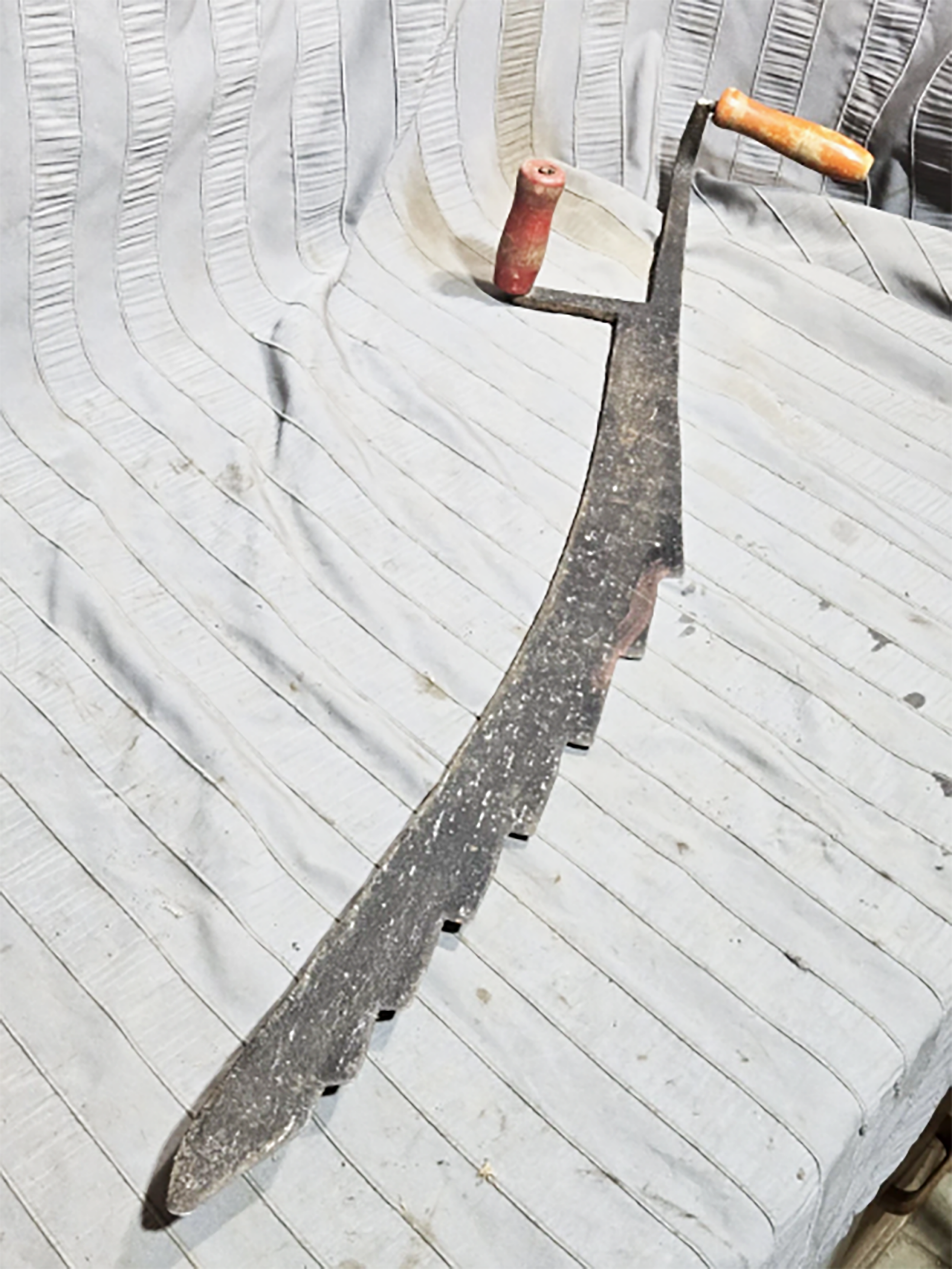
At first glance, an old hay knife can look like a tool designed for something much more dramatic. The long handle, heavy steel and serrated blade don’t resemble anything most producers use around a modern hay barn. A century ago, though, it solved an ordinary feeding problem.
Before balers packaged hay into uniform bales, much of it was stored loose in stacks or packed into haylofts. Under its own weight, cured hay settled and compressed. Loose hay wasn’t fluffy once it had spent months in a loft, and pulling from the face of a mow could bring down far more hay than a farmer wanted. Getting a feeding out could turn into a wrestling match with tangled stems.
The hay knife cut a clean section from that compacted mass. Farmers pushed or sawed the blade down through the stack, then pulled out the slice for their livestock. Cutting a section kept the feeding face manageable and cut down on the loose material that had to be wrestled apart.
Designs varied. Some had straight forged blades. Others used deep serrations, offset handles or footrests that let the user force the blade through dense hay. Some look like oversized bread knives, with a long serrated edge and handles offset from the blade. Others are shorter, curved or built with a foot pedal.
The Henry Ford museum has examples dating from the 1840s through the late 1800s. One patented design from the 1870s, with offset handles and a serrated blade, became a common form. Other inventors added foot pedals or changed blade shapes to make the work easier. Patents from the late 1800s show how important the tool once was. Inventors experimented with serrations, handles and leverage because farmers used the knife every day through the winter feeding season.
The tool faded as hay handling changed. Mechanical balers compressed hay into packages farmers could move and feed without carving pieces from a stack. Modern round and square bales brought their own tools and equipment, and the old hay knife lost its daily job.
That is why the hay knife makes a good first entry in our series about old farm tools. It looks strange only because the job around it disappeared.
If you find one in an old barn, at an auction or in an antique store, look for a long blade, often serrated, attached to handles positioned so a worker could push downward. The variety of designs makes identification tricky, but the common clue is a cutting surface meant to move vertically through a dense mass of hay. It may be rusty and dull now, but in a barn full of loose hay, it was once as practical as a bale knife is today.
Resist the temptation to sharpen it and put it to work before checking its condition. Old steel can be cracked, handles can be loose and rust can hide damage. As an artifact, its best value may be in what it teaches rather than what it can still cut.
That is the fun of looking at old tools. They make more sense once the vanished chore comes back into view.
By NTFR Staff
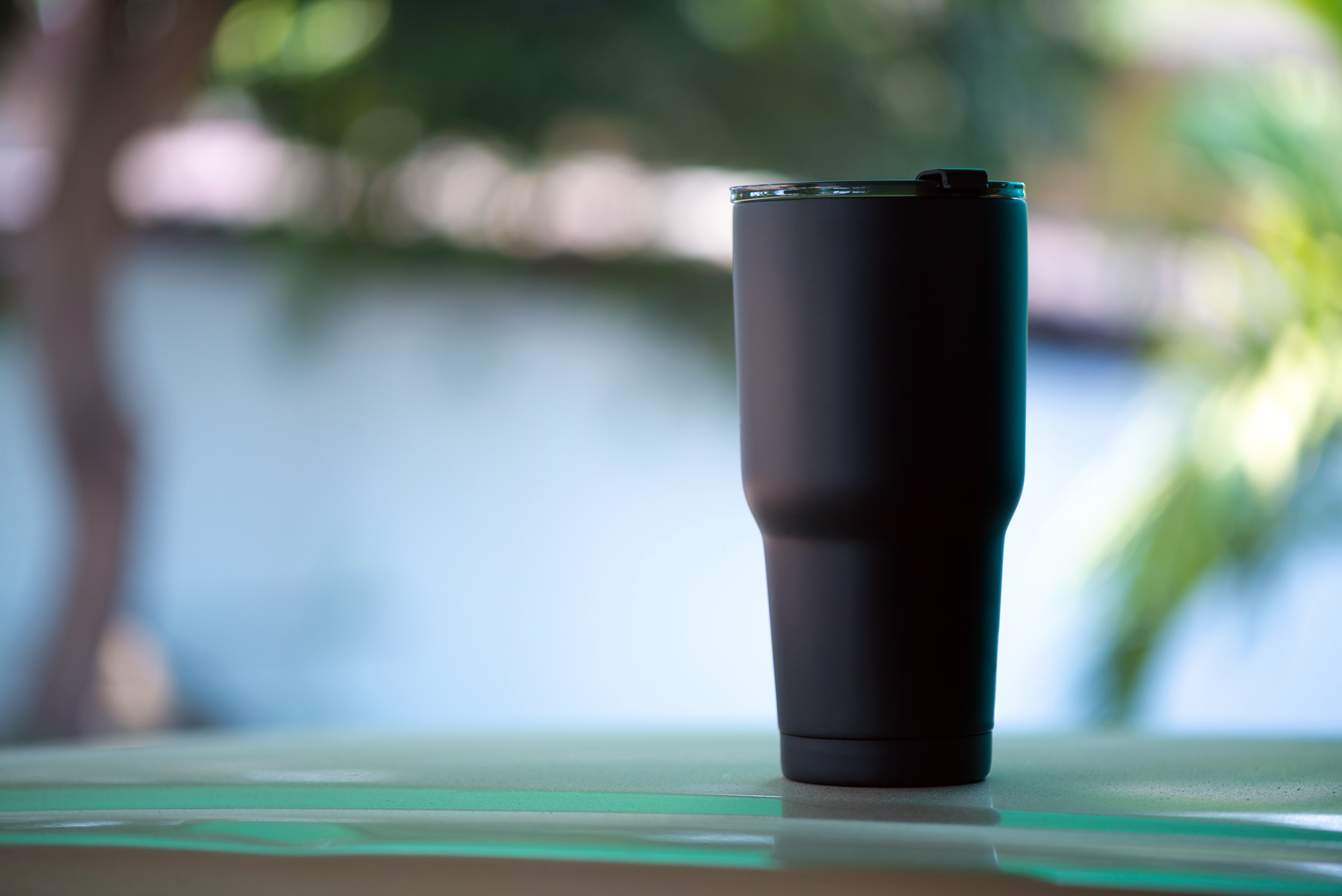
Long before insulated tumblers became a fashion accessory, a vacuum bottle rode beside the lunch pail. It went to construction sites, schoolhouses, hunting camps and tractor cabs. On farms and ranches, it carried coffee through a cold morning and cold water through a hot afternoon.
The idea began in a laboratory. Scottish scientist Sir James Dewar developed the vacuum flask in 1892 while working with very cold substances. His design placed one container inside another and removed much of the air between the walls. With less air to carry heat, the contents changed temperature much more slowly.
German glassblower Reinhold Burger and his business partner Albert Aschenbrenner adapted the scientific flask for household use and protected the fragile inner bottle with a metal case. In 1904, a naming contest produced “Thermos,” from the Greek word for heat.
The American Thermos Bottle Company formed in 1907, and the product found an audience far beyond laboratories. Early advertisements emphasized travel, work and the outdoors. The screw-on cap doubled as a drinking cup, and the bottle became a natural companion to the metal lunch box.
During World War II, Thermos factories devoted most of their production to bottles for military and specialized uses. By the middle of the century, the vacuum bottle had become an ordinary part of American work life. In 1966, the company introduced its first stainless steel vacuum bottle, moving the design away from fragile glass liners.
The word “thermos” became so common that people started using it for almost any insulated bottle. The company has spent decades trying to preserve the distinction.
Part of the workday
For rural America, the Thermos was always more than a clever piece of physics. It was part of the workday. If the pickup was going to be miles from the house until dark, lunch and coffee had to go with it.
The vacuum bottle arrived just as transportation was changing for farm families. People traveled farther to school and work, and trucks and tractors kept workers away from the farmhouse for longer stretches. Carrying a hot drink safely became a small convenience with real value.
Early glass liners worked well but broke easily. Anyone who remembers an old bottle remembers the unmistakable rattle of a broken liner. Stainless steel eventually made insulated bottles tougher and better suited to pickup floors, saddlebags and job sites.
The image was powerful enough that the vacuum bottle became part of the standard lunch kit. Children carried character lunch boxes with matching bottles. Railroad workers, oilfield crews and ranch hands carried larger versions built for long days away from a kitchen.
The physics
The physics is simple. Heat normally moves by conduction, convection and radiation. A vacuum between the inner and outer walls sharply cuts conduction and convection, because very few molecules remain to carry heat across the gap. Reflective surfaces and insulated lids help reduce the rest of the transfer.
That scientific origin makes the ordinary work bottle more interesting. A device invented to solve a laboratory problem ended up beside sandwiches wrapped in wax paper and coffee poured before daylight.
Technology has changed the container, but people carry one for the same reason. Today’s bottles may use stainless steel, better seals and new shapes, but the basic idea is still recognizably Dewar’s 19th-century laboratory flask.
The category has exploded into mugs, tumblers, food jars and giant handled cups, but the old pint bottle still makes sense. It is compact, refillable and designed around one problem: keeping the temperature inside from becoming the temperature outside.
By Lacey Vilhauer
Ingredients
- 3 ounces unsweetened chocolate, coarsely chopped
- ½ cup butter
- 2¼ cups sugar, divided
- 2 eggs
- 1 teaspoon vanilla
- ⅔ cup all-purpose flour
- ¼ teaspoon baking soda
- 68 Kraft caramels (1½ bags), unwrapped
- ⅔ cup evaporated milk, divided
- 1 tablespoon water
- ⅓ cup butter
- One 7-ounce jar marshmallow creme
- ¼ cup creamy peanut butter
- 12 ounces semisweet chocolate chips
- ¼ cup butter
- ¼ cup whipping cream
Instructions
- In a medium saucepan, combine the unsweetened chocolate and ½ cup butter.
- Cook and stir over low heat until melted and smooth.
- Remove from heat and cool slightly.
- Meanwhile, preheat the oven to 350 degrees F. Line a 13x9x2-inch baking pan with nonstick foil, extending the foil over the edges of the pan.
- For the brownie layer, stir 1 cup of the sugar into the chocolate mixture. Add the eggs one at a time, beating with a wooden spoon after each addition just until combined. Stir in the vanilla.
- In a small bowl, stir together the flour and baking soda.
- Add the flour mixture to the chocolate mixture and stir just until combined.
- Pour the batter into the prepared pan, spreading evenly.
- Bake for 15 to 17 minutes, or until the edges start to pull away from the sides of the pan.
- Cool on a wire rack, then place in the freezer.
- For the caramel layer, combine the caramels, 2 tablespoons of the evaporated milk and the water in a large microwave-safe bowl.
- Microwave until smooth.
- Spread the caramel mixture evenly over the brownie layer, spreading to the edges. Place the pan in the freezer while you prepare the nougat layer.
- For the nougat layer, combine the remaining 1¼ cups sugar, the remaining evaporated milk and ⅓ cup butter in a medium saucepan.
- Bring to a boil over medium-high heat, then reduce the heat to medium.
- Simmer, uncovered, for 5 minutes.
- Remove from heat.
- Stir in the marshmallow creme and peanut butter.
- Pour the marshmallow mixture over the caramel layer, spreading to the edges. Place the pan in the freezer while you prepare the chocolate layer.
- For the chocolate layer, cook and stir the chocolate chips, ¼ cup butter and whipping cream in a small saucepan over low heat until melted and smooth.
- Pour the chocolate mixture over the nougat layer, spreading to the edges.
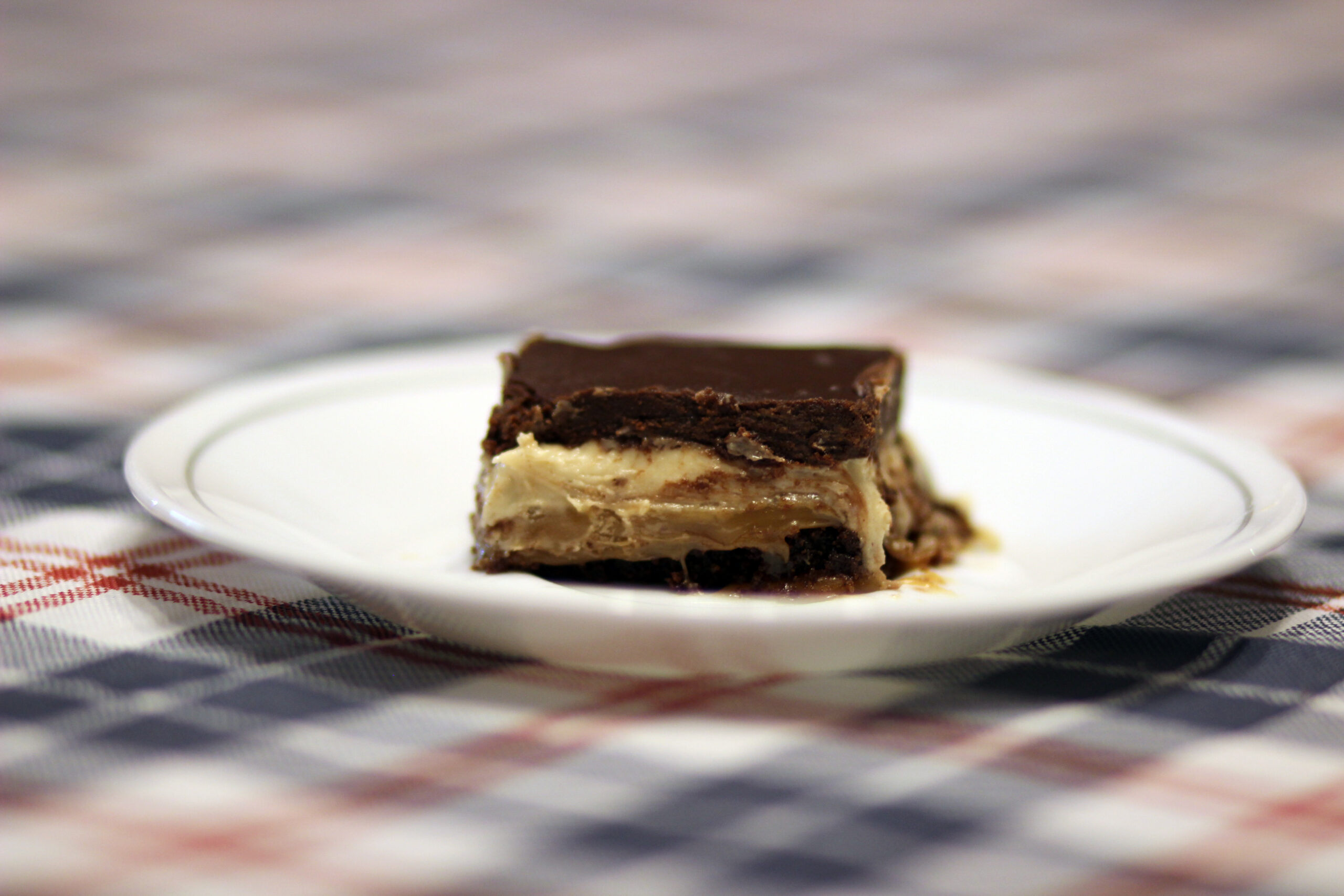
- Freeze for an hour, then cut into brownies. Store covered in the refrigerator for up to 3 days.




-
 Country Lifestyles4 years ago
Scott & Stacey Schumacher: A Growth Mindset
-
 Country Lifestyles10 years ago
Style Your Profile – What your style cowboy hat says about you and new trends in 2017
-
 Horsefeathers13 years ago
Mount Scott: Country Humor with David Gregory
-
 Outdoor11 years ago
Buttercup or Primrose?
-
 Country Lifestyles10 years ago
June 2016 Profile – The man behind the mic: Bob Tallman
-
 Country Lifestyles10 years ago
December 2016 Profile, Rusty Riddle – The Riddle Way
-
 HOME10 years ago
Grazing North Texas – Wilman Lovegrass
-
 The Natural Horseman9 years ago
This is why we do what we do — RayeAnn and Cisco