
Farm & Ranch
Texas crop, weather report for Nov. 24, 2015

By: Robert Burns
AgriLife Expert: 2015 is ‘jubilee’ year for deer hunting
Writer: Robert Burns, 903-834-6191, rd-burns@tamu.edu
COLLEGE STATION – Thanks to plenty of rain at the right times, the 2015 hunting season has been a “jubilee year” for the white-tailed deer crop, according to a Texas A&M AgriLife Extension Service wildlife specialist.
“The deer crop this year has been fantastic,” said Dr. Jim Cathey, AgriLife Extension wildlife and fisheries program leader at College Station. “There are a lot of happy hunters out there.”
Download or preview a two minute MP3 audio version of this report
The economic impact in Texas for hunting was $3.65 billion in 2011, a drought year, and the most recent year for which he has statistics, Cathey said.
“Of that, deer hunting alone counts for $2.16 billion,” he said. “So it’s a pretty important economic driver for our state and wildlife conservation in Texas.”
Cathey noted that it’s been a very good year for other types of hunting, particularly quail, as numbers are back up.
Cathey noted that because 2011 was a drought year, which meant poorer crops of deer and other game animals, he would expect the economic impact for this year to be better.
“We should probably have brand new numbers within a year,” he said. “But I can’t say they will be higher because everything depends on license sales and related items. But drought or not, it’s definitely worth getting the license, not only for the importance of going out there and enjoying wildlife recreation but for the contribution the hunter conservationist makes back into the management of wildlife.”
AgriLife Extension district reporters compiled the following summaries:
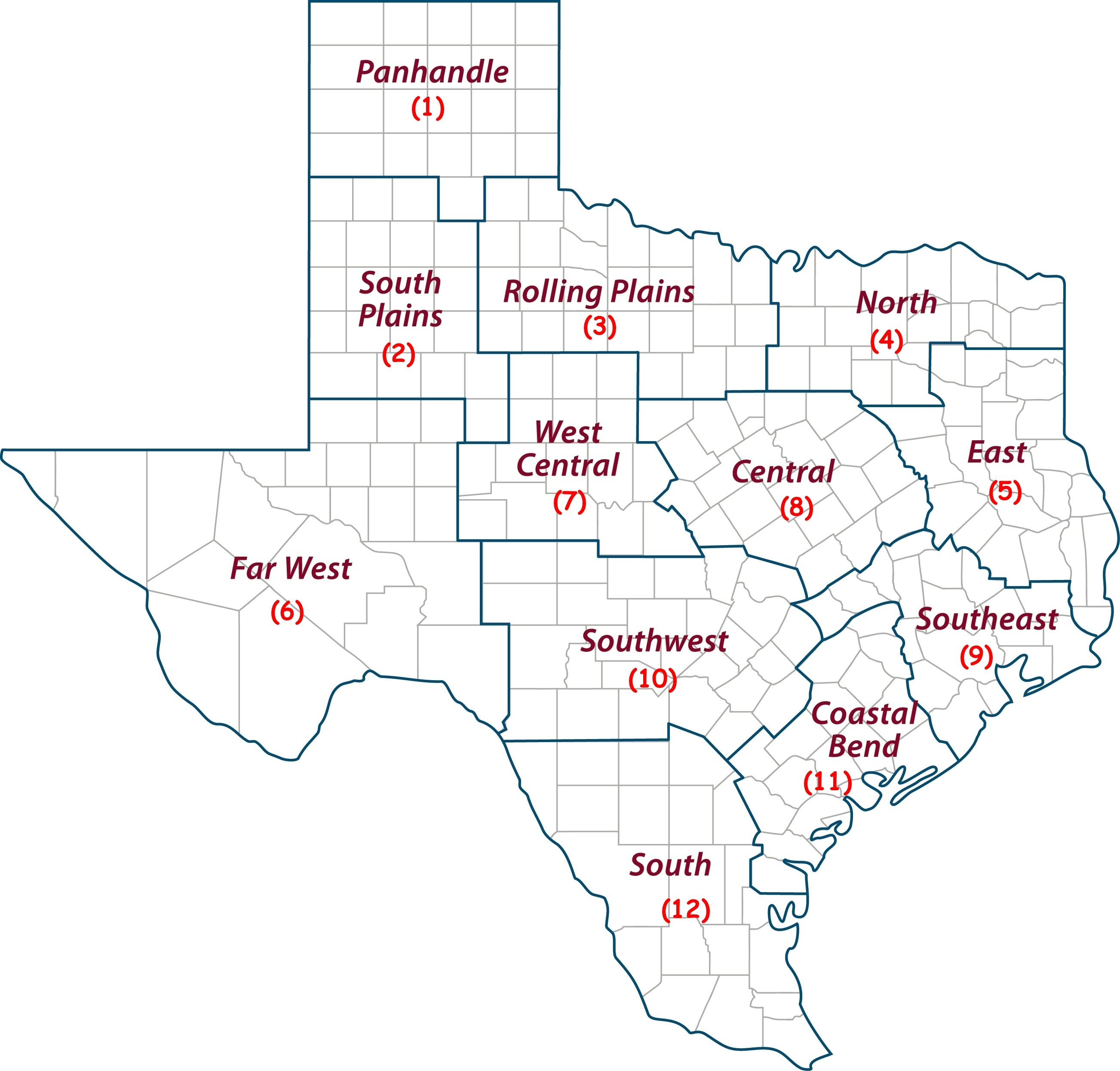
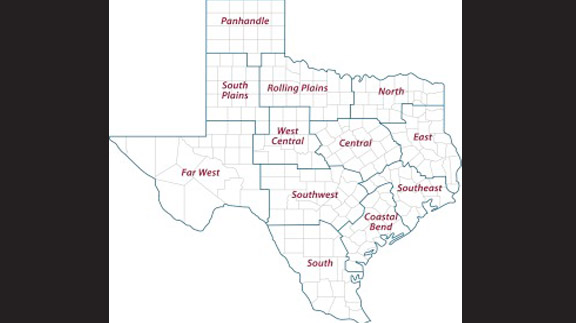
Central: Crops, soil moisture, rangeland, pastures and livestock were all rated as being in good condition throughout the region. However, in many areas saturated soils were expected to delay wheat planting another 10 to 14 days. Stock-water tanks were full. Some producers were still harvesting cotton. Some corn and forage silage still needed to be harvested as well. Growing conditions remain good. The condition of pecan crops remained mixed.
Coastal Bend: The region received more rain, which was welcome as it fortified soil moisture levels going into winter. Winter pasture planting was completed. Some producers were applying fertilizer on drier fields. The first frost occurred in the northern portion of the reporting area. The pecan harvest continued, with good yields in improved orchards. Livestock market prices dipped. Cattle were in good condition.
East: The region received from 1 inch to 3 inches of rain, saturating already wet fields and causing flooding in some areas. Henderson County producers had to contend with flood-related issues on roads, fences and corrals. However, the moisture and cooler temperatures improved winter forages. Some producers were seeing slow growth of forages due to delayed planting caused by the dry weather in mid-October and early November. Some areas reported the first freeze Nov. 21-22, which caused warm-season grasses to finally enter dormancy and allow cool grasses to grow. Cattle were mostly in good condition. Producers were supplementing livestock with feed and hay. Hay quality was poor. Most spring-born calves were marketed. Fall calving was in progress. Marketing of cull/market cows continued. Feral hogs continued to be a problem in many areas.
Far West: The entire region had warm days with cool to cold nights. El Paso County had its first freeze, which sped up the opening of pecan shucks. The freeze also sent onion and alfalfa crops into dormancy. Ward and Culberson counties had rain showers. High winds from passing of cold fronts dried out topsoils but also increased high wildfire danger. Cotton harvest proceeded at full tilt and was expected to be finished soon. Farmers continued sowing winter wheat and already emerged fields looked good — with the exception of a few areas where soils were deficient in nitrogen due to standing water. Producers were wrapping up fall cattle work, with some cull cows being shipped and others being fattened up for sale early next year. Pastures were green with winter weeds. Trees, except for mesquite, were starting to turn color. Topsoil and subsoil moisture remained adequate.
North: Topsoil moisture varied from adequate to surplus. Some areas received from 0.5 inch to 2 inches or rain. Wheat fields and pastures were wet and muddy. Wheat stands were rated as fair to average, but late planting due to dry conditions delayed grazing. Warm-season grasses in rangeland and pastures conditions were declining due to colder weather, but winter grasses and legumes were coming on. Many ranchers were starting to feed hay and provide some supplemental protein. Livestock were in good condition. Wild hogs were active.
Panhandle: Temperatures were near average. Severe weather early in the reporting period brought rain, hail, high winds and tornados to some areas. Soil moisture continued to be rated mostly adequate. Collingsworth County cotton yields continued to be average to above average, but grades were coming in low. Much of the irrigated cotton crop was harvested. Deaf Smith producers had all but wrapped up harvesting of corn, most grain sorghum and hay. The winter wheat crop there was looking good despite some disease issues already appearing in early planted wheat. Producers continued planting some wheat behind late corn and some harvested sorghum fields. Manure spreading and fertilizing for next year was ongoing. Stocker cattle were being placed on wheat pasture in increasing numbers. Gray County had tornados. Hansford County rain slowed down cotton harvesting, but early reports indicated quality will be lower than anticipated. Lipscomb County had storm damage in some areas. In Moore County, the grain harvest was almost completed, while the cotton harvest continued in full swing. Randall County had an early taste of winter weather with 60 mph winds all day on Nov. 16. Fieldwork was delayed due to about 1 inch of rain and the extremely windy conditions. Wheeler County ranchers were providing supplemental protein to cow herds. A killing frost allowed cotton producers to begin harvesting if they had not utilized defoliants. Wheat was improving with recent moisture.
Rolling Plains: Some areas received from 0.5 to 1 inch of rain. Wheat planting continued where possible under largely favorable but wet conditions. Some areas were about 70 percent planted. The cotton harvest was delayed by wet field conditions but should was expected to resume by Thanksgiving. Rangeland, pastures and livestock were in good condition. Producers were able to put only limited numbers of stocker calves on earlier-planted wheat pastures due to wet conditions and late planting.
South: The region continued to have warm days and cool nights. No rainfall was reported anywhere in the region. Soil moisture was adequate throughout the region. In the northern part of the region, harvesting of peanuts continued. Armyworms were found in winter forages, and the first freeze of the year occurred over the weekend of Nov. 21-22. Wheat and oats were planted, with the most fields already emerged. Forage quality continued to improve, and less supplemental feeding of beef cattle herds was required. In the eastern part of the region, beef cattle producers were actively marketing calves and culling cows prior to winter. Rangeland and pastures remained in good condition. In the western part of the region, spinach harvesting was active, with the cro in different stages of maturity throughout the area. Baby-leaf spinach harvesting for the fresh market was particularly active. Cabbage crops also made good progress. With good grazing available, livestock on native range and pastures continued to do well. No supplemental feeding was needed. Onions progressed well, and oats and wheat emerged and were making good progress. In the southern part of the region, sugarcane harvesting was underway in Hidalgo County. Fall vegetable crops progressed well in Starr County. Rangeland and pastures remained in good condition throughout the area.
South Plains: Many areas had their first hard freeze along with some rain. Floyd County received 0.5 inches of rain and very high winds early in the week, which kept farmers out of fields for a day or two. Otherwise, they continued to wrap up the cotton and grain harvests. Most expected to finish by Thanksgiving. In Cochran County, soils were drying out from lack of moisture and high winds. The cotton and grain sorghum harvests were ongoing. Producers were still planting winter wheat. Pastures and rangeland were in good condition. Lubbock County received rain on Nov. 16. Amounts varied, with heavier rain on the eastern part of the county. The city of Slaton got 0.9 inches. A killing freeze was finally registered for Lubbock: 28 degrees on Nov. 21 and 25 degrees on Nov. 22. Harvest and ginning were proceeding well. Stocker cattle on wheat pasture look good. In Garza County, cotton harvesting continued despite 0.3 inches of rain early in the week. Fields dried out within a couple of days thanks to moderate winds, and harvest resumed. Rangeland and pastures were mostly in good condition. Producers provide supplemental feed to cattle in areas that had been more intensively grazed and on the days where temperatures were below freezing. Scurry County also reported their first freeze on Nov. 23. Winter pasture planting was completed.
Southeast: Soil-moisture levels throughout the region varied widely, but were mostly in the adequate to surplus range, with adequate being the most common. Walker County reported 100 percent adequate soil moisture. Rangeland and pasture ratings were mostly fair to good, with fair ratings being the most common. After recent rains, Waller County pastures were looking much better. There were some reports of armyworm activity in small grain winter pastures. Brazoria County had standing water in fields. Chambers County also had very wet conditions. Most fieldwork may be delayed until spring by the wet soils.
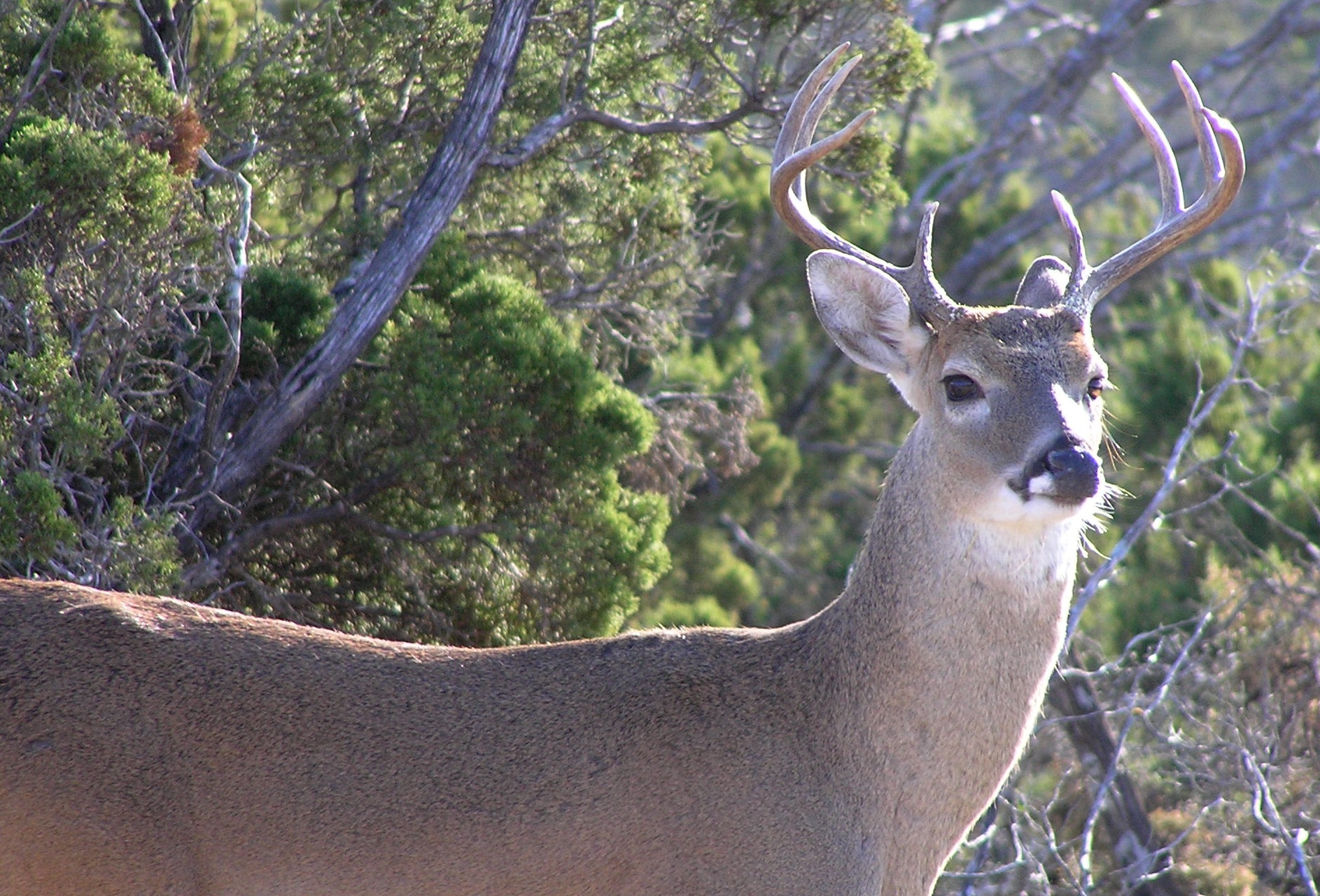
Southwest: The pecan harvest continued, and farmers were still planting winter crops as temperatures began to fall. Livestock were in fair condition. The deer hunting season has been one of the best in many years, with quality antlers and great deer movements. Pastures were improving.
West Central: The region had mild days with cold nights. Some areas had their first light frost. A few areas received isolated showers. Soil moisture was rated as good in most counties. The cotton harvest continued, with about half of the crop out of the fields. Irrigated cotton yields were good, and dryland yields fair. Quality grades decreased due to the wet conditions. Winter wheat was off to a good start thanks to the recent rains. No insect problems were reported. Producers continued to plant winter wheat behind cotton harvesting. The sesame harvest began. Range and pasture were in great condition and providing some grazing. Winter weeds and grasses were also coming on strong. Livestock were in fair to good condition going into winter. Cattle prices were still holding steady. The pecan harvest was underway.
-30-


Find more stories, photos, videos and audio at http://today.agrilife.org
By Tony Dean
Farmers and ranchers are in a very close partnership with Mother Nature. If we really pay attention, she presents us some interesting scenarios.
For example, though they are totally different types of plants, water lilies and prickly pear have a lot in common. They both have strikingly beautiful flowers, both plants are edible, both of them are invaders into their respective habitats, and too much of either one can be an obstacle that we have to deal with.
Many north Texas ranches rely on excavated ponds for livestock water. Any time a pond contains a significant amount of shallow water so that sunlight reaches the bottom, some type of pond weed will develop. The plant family that includes water lilies and lotuses is a common invader in our livestock water.
Water lilies and lotuses are in the same plant family but they are two separate genera. There are easy ways to tell them apart:
- A primary difference is that water lily leaves commonly float on the surface, but lotus leaves can grow above the water line.
- Water lily leaves and flowers are thick and waxy, while lotus leaves and flowers are thin and papery.
- Water lily leaves have a distinct notch in the leaf, while lotus leaves are more rounded.
- Water lily flower petals are pointed, and lotus petals are more rounded.
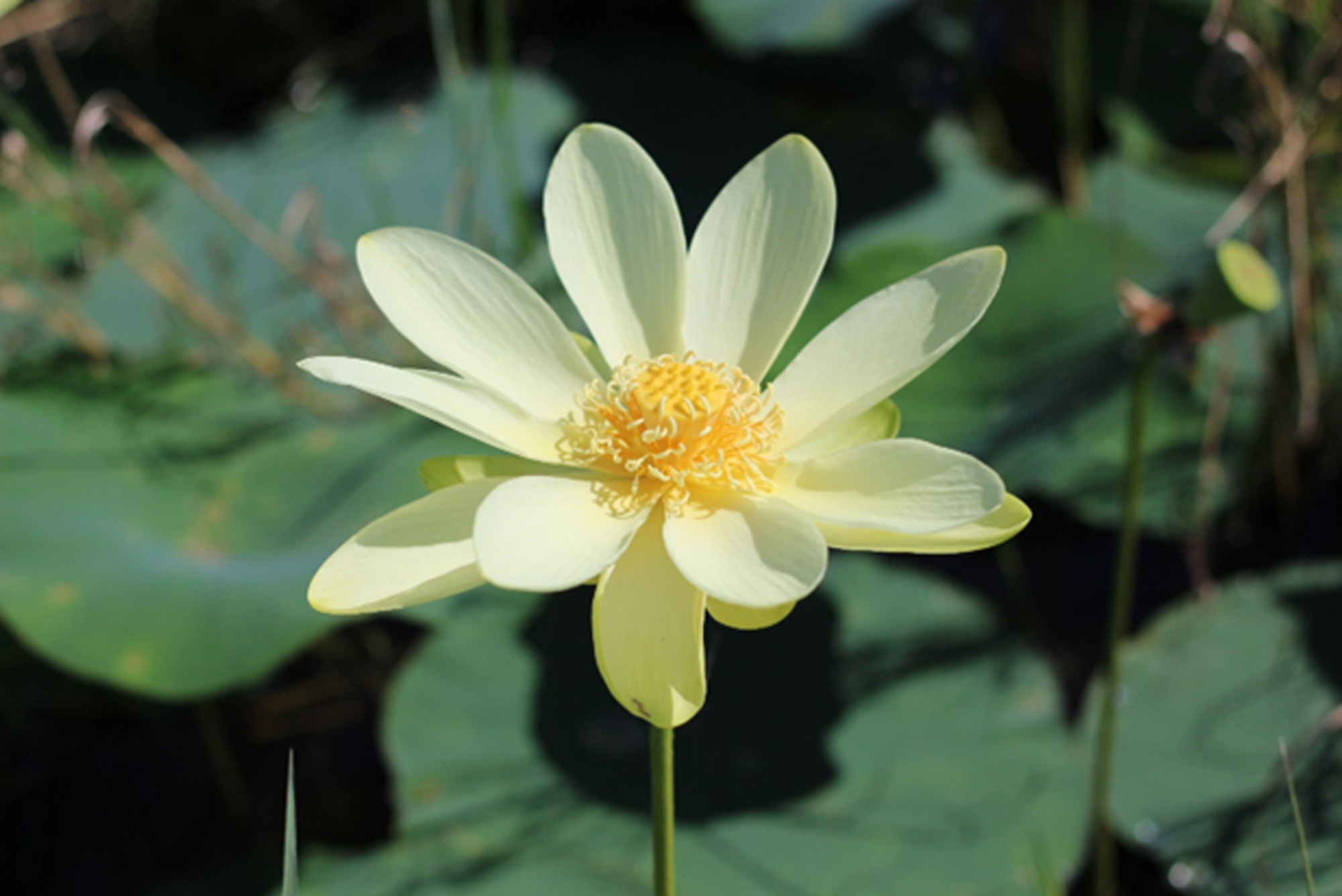
The photos attached to this writing are from Clay County, and this plant is common across north Texas. American lotus is adapted to a wide area, from Honduras north through Mexico and across the eastern US and into Canada.
American lotus is a perennial, and it is cold tolerant and heat tolerant. It can grow in any pond or slow moving stream that contains shallow water areas. It prefers water with a depth of about 12 inches. Germination can occur from the large lotus seeds. Tubers, or roots, are established in the mud, and long slender stems extend upward. Leaves and flowers are both emergent in that they grow above the water line.
Lotus flowers are fragrant, and yellowish white with rich gold centers. They open in the morning and close by late afternoon, then open again the next day.
Lotus is an edible plant and has a history as a food source. The large tuberous roots, the size of a human arm, were baked like sweet potatoes. The leaves were eaten like spinach, and the large seeds were ground into flour. Stems taste somewhat like beets and were usually peeled before being eaten.
There is a large world-wide industry of cultivating lilies and lotuses in water gardens. According to Dr. Jerry Parsons, Professor and Extension Horticulturist with Texas A&M AgriLife Extension, cultivation of these plants dates back as early as ancient Egypt. Today, anyone with determination and a little money can have a water garden.
In 2011, the 82nd Texas Legislature designated the water lily “Texas Dawn” as the official Texas State Water Lily. Texas Dawn is a hybrid developed by Texas resident Kenneth Landon, a world-renowned expert in the field of water lilies and the director of the International Water Lily collection in San Angelo.
Ducks and other wildlife utilize the large acorn like seeds of American lotus, and submerged portions of all aquatic plants provide some form of wetland habitat. Many of us have tried to pull a bass out of a group of water lilies or lotuses, and I’m sure others have had better luck than I did. Although there can certainly be benefits to lilies, lotuses, and other aquatic plants, they can also infest ponds to the extent that the pond is not functioning correctly.
So, while the rest of the world works hard to grow these plants, ranchers sometimes need to control populations in their stock ponds. Once it gets a foot hold, American lotus can spread aggressively in wetland areas.
The primary issue that encourages American lotus, and most other water weeds, is shallow water. Look closely at a good livestock pond and you will find that the deeper water is basically free of infestation. Any pond will have a certain amount of shallow water that encourages water weed growth, depending upon the terrain at the pond site and how the pond was constructed. Some ranchers who enjoy and utilize wetland habitat may prefer to have ponds with significant shallow water area.
Almost all livestock ponds have a certain life expectancy. Siltation, or movement of soil into the pond bottom through rainfall runoff, is a natural occurrence. How fast siltation occurs into each pond, and how deep the pond was to start with, determines the length of time that the pond will contain adequate depth for dependable water for livestock.
Ponds that develop infestations of water weeds over a large percent of the surface may not have adequate depth to remain a viable water source for livestock during drought periods, especially in western north Texas where evaporation rates are higher.
Mud, or silt, from the pond bottom, can be removed to deepen the water, but this is a very expensive process. It is often more economical to construct a new pond rather than try to remove the silt from an old one. Most of us do not have the funds to continually construct deep water livestock ponds, so we must try to keep existing structures functioning and providing good drinking water for livestock, for as long as we can. Control of pond weeds like American lotus may be necessary, and it can be accomplished.
There is currently no feasible biological control. American lotus can be cut and removed, but this process us usually temporary because lotus can reestablish from seeds and roots.
American lotus can be safely controlled by chemicals. This must be done carefully. If a pond containing a large amount of any pond weeds is treated to remove all of the vegetation, a fish die-off could occur. When the dying weeds decompose, they use up the oxygen in the water and fish can suffocate. If possible, treat only a portion of the area, wait about two weeks, and treat another portion.

This morning, I walked out into my arena and noticed something that gave me pause. The roping steers had been in there the day before, and even though the ground was wide and level, the sand carried their story. Hoofprints crossed every direction, but in several spots, the same trail was pressed deeper than the rest. Twelve steers had been turned out, yet more than a few chose the exact same path, wearing it down until it stood out from all the other tracks.
Cattle are creatures of habit. Anyone who has spent time around them knows this. They like routine: the same feed, the same water trough, the same shade tree in the pasture. When they are turned loose, they rarely wander without purpose. More often than not, they move together, following the same course as the steer in front of them. There are reasons for this: efficiency, safety, instinct. Walking a beaten path conserves energy, and following the herd is their natural defense. Even in an arena with no real destination, those instincts come through. By the end of a short turnout, you will see the evidence, lines where they have chosen the easiest way to travel and stuck with it.
Out on the range, those lines last longer. Before fences and highways, cattle drives cut deep paths across the land. The Chisholm Trail, which carried herds north from Texas through Oklahoma into Kansas, was walked by millions of cattle in the late 1800s. More than a century later, faint traces of those trails remain, worn so deep by hooves and wagon wheels that the land still carries the mark. On ranches today, you can see the same effect in pastures where cattle walk the same lines between water and grazing. From the ground those trails might look like nothing more than dusty ruts, but from the air, they sometimes stand out as sharp lines winding through otherwise open fields. Cattle do not simply pass over the land; they shape it. Every step adds up.
That simple truth extends beyond livestock. We all make tracks. Our habits and routines are our trails, worn in by repetition, sometimes efficient, sometimes limiting. Like the cow paths, they can serve a purpose, keeping us steady and helping us move forward. But when repeated without thought, they risk becoming ruts, keeping us from stepping into new ground. History offers perspective here too. The old cattle trails built towns and economies, but once railroads and fences changed the landscape, those paths were no longer useful. Sticking to them would have meant going in circles. Progress required something new.
The Tracks We Leave
Standing in the arena, I thought about the kind of tracks I leave behind. Most of mine are not visible in the dirt. They are pressed into my daily life, how I work, the way I handle challenges, the example I set. Some are helpful and worth keeping. Others may have outlived their purpose. The difference comes in knowing when to stay in the track and when to step out of it.
Tomorrow I will drag the arena and smooth it all clean again. The next time the steers are turned in, they will make the same trails. That is their nature. But unlike them, I have a choice. I can decide which paths are worth walking, which ones to change, and what kind of tracks I want to leave for others who might follow.
Tracks tell a story. Sometimes they are only temporary, fading with the next rain. Other times they last for generations, reminders of where herds and people once walked. This morning, the cattle showed me again that even the smallest things on the ranch carry meaning. Their tracks in the arena were not just marks in the sand. They were a lesson: every step matters, and the paths we choose shape more than just the ground beneath our feet.
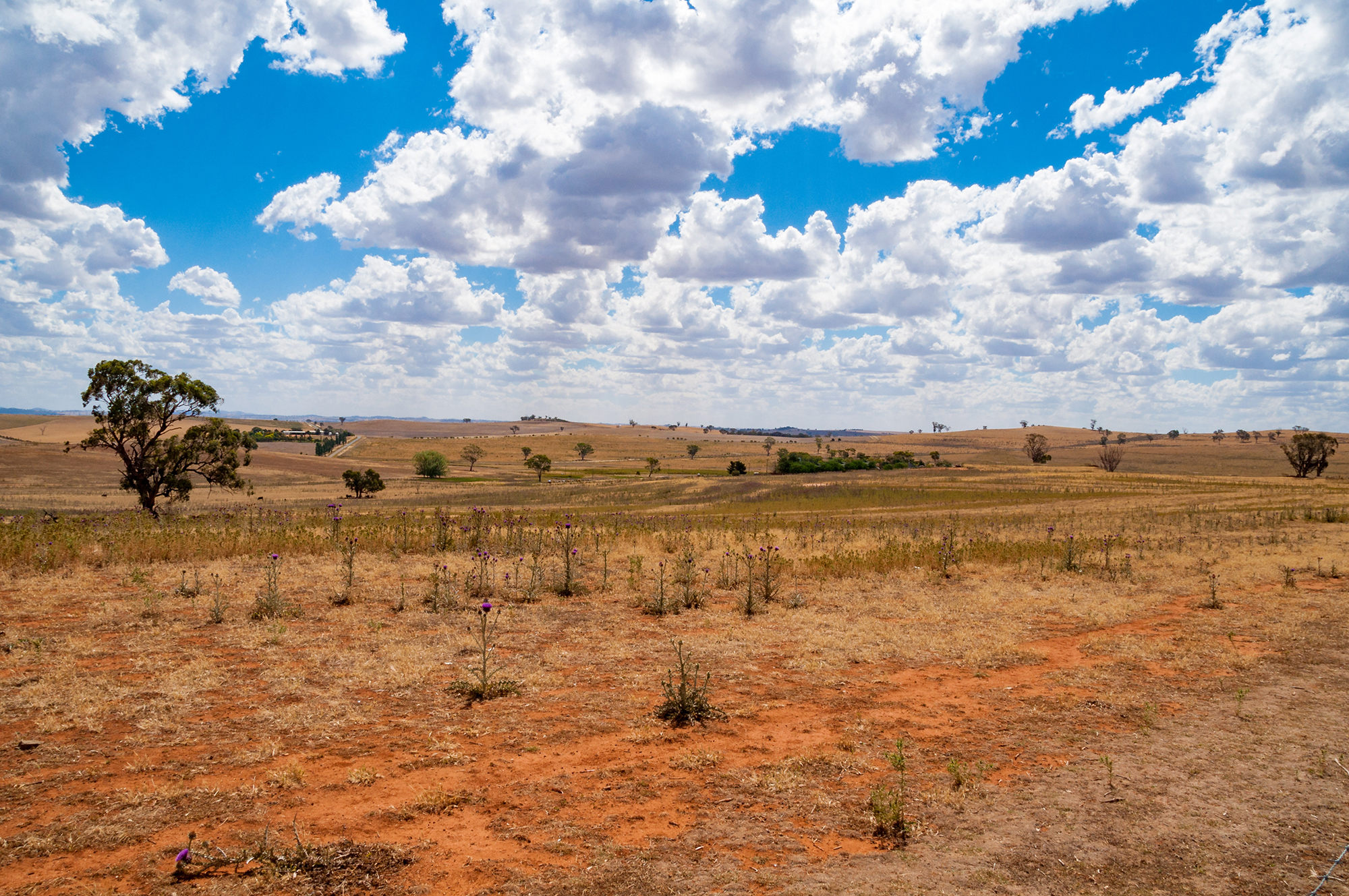
By Raenne Santos
Known as the father of wildlife management, Aldo Leopold’s teachings reshaped our understanding of conservation and our role in nature. His philosophy, rooted in ethics, ecology, and action, emerged in response to the environmental degradation of the early 20th century in the American West. Overgrazed pastures, eroding soils, and changing wildlife populations revealed the consequences of treating natural resources as limitless.
Recognizing these challenges, Leopold theorized a transformative approach to land stewardship, emphasizing that the land is not merely a commodity, but a community in which we all belong. His works, A Sand County Almanac and Land Ethic, are still referenced to this day by modern conservationists. In Land Ethic, he introduced a practical framework for wildlife management known as the Five Tools of Wildlife Management, which offers land stewards a structured approach to maintaining and restoring ecological balance.
Symbolizing brush management, the axe is one of Leopold’s tools for controlling invasive species, shaping habitats, and mitigating wildfire risks. By selectively removing vegetation, land managers can enhance biodiversity, create open spaces for native species, and maintain healthy ecosystems.
Representing grazing animals, the cow (when used properly) mimics the natural disturbances once provided by bison. Grazing animals promote healthy ecosystems by aiding in nutrient cycling and soil disturbance. Responsible grazing practices prevent overuse and contribute to sustainable land management.
The plow signifies mechanical disturbance and soil preparation, crucial for habitat restoration and agricultural productivity. Used strategically, it aids in cultivating crops and creating conditions favorable to wildlife. However, misuse can lead to erosion, requiring careful application in conservation efforts.
Fire, a powerful natural tool, plays a crucial role in maintaining biodiversity and landscape resilience. Land managers use prescribed fire to control invasive species, rejuvenate plant communities, and shape habitats. Fire promotes the natural cycles of ecosystems and supports species diversity.
The final tool, the gun, is used to manage game populations and control predators. During Leopold’s time, unregulated hunting contributed to species extinction and posed threats to others. Today, hunting is strictly managed through game laws and seasonal regulations to ensure sustainable populations.
Leopold’s Five Tools of Wildlife Management continue to influence conservation practices today. While techniques have evolved, the fundamental principles remain the same—balancing human involvement with ecological processes to sustain healthy ecosystems. His approach emphasizes the importance of working with nature rather than against it. By embracing ethical land stewardship, modern conservationists honor Leopold’s vision, ensuring that future generations inherit thriving landscapes.





-

 Country Lifestyles3 years ago
Scott & Stacey Schumacher: A Growth Mindset
-
 Country Lifestyles9 years ago
Style Your Profile – What your style cowboy hat says about you and new trends in 2017
-
 Horsefeathers12 years ago
Mount Scott: Country Humor with David Gregory
-
 Country Lifestyles10 years ago
June 2016 Profile – The man behind the mic: Bob Tallman
-
 Country Lifestyles10 years ago
December 2016 Profile, Rusty Riddle – The Riddle Way
-
 Outdoor11 years ago
Buttercup or Primrose?
-
 HOME9 years ago
Grazing North Texas – Wilman Lovegrass
-
 The Natural Horseman9 years ago
This is why we do what we do — RayeAnn and Cisco