Equine
A busy schedule – Activities for the equine enthusiast

By Krista Lucas
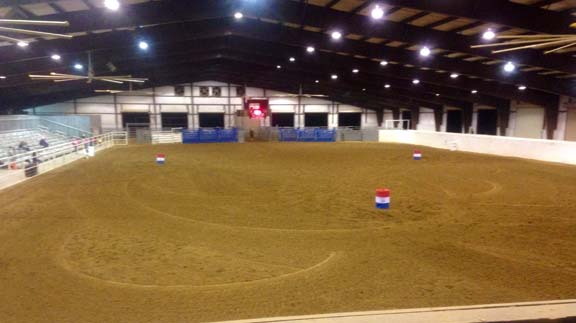
North Texas is known as horse country in many areas. The region is home to numerous horse ranches, breeding facilities and boarding barns. On any given day of the week, there are places to go for horse lovers of any age to compete or watch an event.
There are several nice facilities located just a short drive away. Many arenas are covered or even completely indoor so weather does not become a factor. For both serious competitors and “just for fun” barrel racers, there are plenty of weekly jackpots to choose from year round. These races offer a family atmosphere, great ground conditions and concession stands.
Barrel racers can attend a jackpot any night of the week in the north Texas area. Starting on Monday nights, Diamond T Arena hosts a barrel racing jackpot beginning at 8 p.m. with exhibition, or “time-only”, runs from 4-7:30 p.m. Diamond T is an indoor arena, located just outside of Denton, Texas. To read more pick up the November 2015 issue of NTFR.

By Savannah Magoteaux
Vaccinations are one of the simplest and most effective ways to protect your horse’s health. Good nutrition, proper hoof care, regular dental work and sound management all help keep horses healthy, but vaccines protect against diseases that can be costly, debilitating or fatal.
Many owners associate vaccinations with foals, but adult horses need routine immunizations throughout their lives. Immunity fades over time, and boosters help maintain protection. Which vaccines a horse needs depends on its age, location, travel schedule and exposure to other horses, but every vaccination program should start with a conversation between you and your veterinarian.
Core vaccines for every horse
The American Association of Equine Practitioners (AAEP) recommends five core vaccines for nearly every horse in the United States. These diseases pose a significant risk because they are widespread, potentially life-threatening or can affect human health.
Tetanus is one of the most important. Horses are particularly susceptible because the bacteria that cause tetanus live in soil and manure. Even a small puncture wound can let the bacteria in. Once clinical signs develop, treatment is difficult and survival rates fall sharply. Annual vaccination is the standard recommendation for most horses.
Eastern and Western equine encephalomyelitis, often called EEE and WEE, are mosquito-borne viral diseases that attack the nervous system. Cases are relatively uncommon, but both diseases carry high fatality rates. Vaccination is the most effective prevention, especially during mosquito season.
West Nile virus is another mosquito-transmitted disease of the nervous system. Since it arrived in the United States, it has become a routine part of every horse’s vaccination schedule. Infected horses may develop weakness, muscle tremors, stumbling or trouble standing. Some recover with supportive care, while others suffer permanent neurological damage or die.
Rabies is rare but almost always fatal once symptoms appear. Because rabies can also infect people, vaccinating protects both horses and the people who handle them. Skunks, raccoons, bats and foxes remain common carriers across much of the country.
Risk-based vaccines
Beyond the core vaccines, veterinarians often recommend risk-based vaccines depending on a horse’s lifestyle. Horses that travel often, show, compete, breed or live where other horses come and go usually need broader protection than horses that spend their lives on a single farm.
Common risk-based vaccines include:
- Equine influenza
- Equine herpesvirus (rhinopneumonitis)
- Strangles
- Potomac horse fever
- Botulism
- Leptospirosis
Veterinarians recommend influenza and equine herpesvirus vaccines most often, because both diseases spread easily wherever horses gather. Boarding barns, rodeos, horse shows, clinics and sales all raise exposure. Horses that compete regularly may get boosters more than once a year to stay protected.
Strangles remains one of the most contagious bacterial diseases in horses. Many horses recover, but outbreaks can race through barns and often force quarantines. Your veterinarian may recommend the vaccine at facilities where exposure risk is high.
Potomac horse fever tends to occur in certain regions and is associated with aquatic insects near streams and ponds. Your veterinarian can tell you whether this vaccine makes sense where you live.
Vaccines don’t replace good management
Vaccines lower disease risk, but they are only one part of a complete health program.
Biosecurity matters just as much. Isolate new horses before they join the resident herd whenever possible. Avoid sharing water buckets, feed tubs and grooming equipment, especially at shows or boarding facilities. Regular cleaning and good sanitation also reduce disease spread.
Control mosquitoes, too. Eliminating standing water, cleaning water tanks regularly and reducing breeding areas can lower exposure to mosquito-borne diseases such as West Nile virus and encephalomyelitis.
Proper nutrition, parasite control and dental care support the immune system and help horses respond better to vaccination.
Timing matters
Most horses get their annual vaccinations in spring, before mosquito numbers climb and the busy travel season starts. Still, no single schedule works for every horse.
Foals need a series of vaccinations because the antibodies they get from their mothers fade during the first months of life. Adult horses that have never been vaccinated may also need an initial series before moving to annual boosters.
Veterinarians often vaccinate pregnant mares several weeks before foaling to raise antibody levels in the colostrum, which helps protect newborn foals in their first weeks.
Performance horses that travel a lot may need extra boosters through the year, particularly for influenza and herpesvirus.
Because recommendations vary with age, pregnancy, travel plans and disease activity, review your horse’s vaccination program with your veterinarian every year instead of repeating last year’s schedule.
Protecting the whole horse community
Vaccination protects more than the individual horse. When a high percentage of horses in a community are properly vaccinated, infectious diseases have a much harder time spreading. That protects young foals, older horses and animals with weakened immune systems.
Disease outbreaks can disrupt horse shows, breeding operations and training facilities, sometimes causing quarantines, canceled events and significant financial losses. Keeping vaccinations current reduces those risks for everyone in the horse industry.
Vaccines can’t prevent every illness, but they remain one of the most valuable tools horse owners have. Combined with sound management, good nutrition and regular veterinary care, a well-planned vaccination program helps horses stay healthy whether they spend their days on the ranch, in the show pen or out in the pasture.
Always consult your veterinarian to build a vaccination program that fits your horse’s age, health, location and level of exposure. Recommendations may vary with disease activity in your area and your horse’s individual needs.

By Savannah Magoteaux, Editor
Some horses show flashes of greatness from the start, but it takes the right time, training and team for everything to come together. Kole Price knew early that Golden Coins had something special, and once the talented stallion found his stride, he quickly became one of reining’s brightest stars. In 2026, the pair capped an already remarkable year with a 237.5 at The Run For A Million, setting a new NRHA record and showing how far a talented horse and a patient horseman can go together.
From the first day Price rode Golden Coins, he knew the young stallion was different. The horse had talent, style and an ability that made Price believe he could become something special. Turning that potential into major wins took a little time.
“He was always good showing, and you could tell that he was special,” Price said. “But he always had a big bobble that kept us from being there.”
Those moments didn’t last long.
When Golden Coins was 4, things began clicking, and then they started happening fast. A win in Las Vegas was followed by success at some of reining’s biggest events. As a 5-year-old, he won the National Reining Breeders Classic and kept proving himself among the best horses in the sport.
As a 6-year-old in 2026, Golden Coins took another step. He swept the NRBC before heading to Las Vegas for The Run For A Million, where Price knew they would face one of the deepest fields of horses and riders ever assembled for the event.
Golden Coins answered with the biggest performance of his career. Price and the stallion marked a 237.5 to win The Run For A Million and set a new NRHA record.
Price had won the event before aboard Gunna Stop, so the victory made him a two-time champion. For Golden Coins, it was the latest accomplishment in a career Price believes is still getting better.
“He’s probably one of the few horses that hasn’t ever been beat in his six-year-old year and has gotten that much better as he’s gotten older,” Price said. “So that’s really special to me.”
Finding what works
Price didn’t arrive in Las Vegas wondering whether Golden Coins could win. He knew the horse could.
After an outstanding showing at the NRBC, Price gave the stallion about two months off from riding. Golden Coins was still working in the breeding shed, but his days included plenty of turnout.
The vacation suited him, at least for a while.
“He loved the turnout, but you could tell after about three weeks he was ready to go,” Price said. “Every time I walked by his stall, he would literally whinny at me.”
Eventually Price got the message and put him back to work.
“That’s what makes those special ones special,” he said. “They like to go to work just like people.”
Once Price began legging Golden Coins back up, his focus turned almost entirely to The Run For A Million.
The expectations surrounding the horse were impossible to ignore. Golden Coins was already one of the most talked-about horses headed to Las Vegas, but Price said that gave him confidence rather than pressure.
“I’d rather show up on a horse that I know and everybody else believes in rather than one you’re kind of really questioning,” he said.
All week, Price kept his world small. He focused on Golden Coins, limited distractions and tried to stay mentally fresh.
When it came time to show, he gave himself one small reminder. Price wrote the word “flow” across his hand, where he could see it while holding the reins.
The word summed up what he believes sets Golden Coins apart.
“He can do all the big maneuvers, but to me the cool stuff is the transitional stuff,” Price said. “The way his topline never changes. He uses his ears. He’s just kind of always there.”
With loud music, an engaged crowd and every rider knowing it would take a huge score, Price wanted to make sure he didn’t abandon the style that suited his horse.
“What I didn’t want was to get caught up in the moment and run a different pattern than what has worked for that horse,” he explained.
During the run, Golden Coins gave him exactly the feeling he had hoped for. After the second set of turns, Price shut the stallion off before the next lead departure, and Golden Coins stood still.
“He stood like a statue,” Price recalled. “He didn’t quiver. His ears didn’t quiver. He didn’t look around.”
For Price, that moment may have said as much about the horse as any sliding stop.
“He was so intense, but he was so relaxed,” he said. “I don’t think I’ve ever felt that. That’s when you know that you’re on right now.”
When they finished, Price knew Golden Coins had given him everything he had.
Five horses still had to show, so Price found a quiet spot between the practice arenas to wait. Talented riders remained, any of whom could win, but for the first time he felt at peace with whatever happened.
“If they beat me, they deserved it,” he said. “I knew they were going to have to be better than perfect to get there.”
They weren’t. Golden Coins’ 237.5 held, giving Price another Run For A Million championship and putting the stallion’s name in the record book.
The team behind the win
The win also belonged, Price said, to a group of people who had been there long before Vegas.
Capital Quarter Horses backed Price through Golden Coins’ early career, including the runs where one mistake kept them from the result they wanted.
“They never questioned me,” Price said. “They just kept saying, ‘Go on. We know it’s going to happen.’”
His wife, Kelsey, has also been an important set of eyes throughout the process. She was in Las Vegas despite being pregnant with their daughter, who is due in October.
“There were a lot of early, early mornings where she’d come out and watch and just be a set of eyes,” Price said. “Even if she didn’t say nothing, it’s just very comforting when she’s there.”
He also credited his barn crew, Don and Joetta Bell, close friend Jason Donahue and Kalina Monroe. Price joked that Don may be Golden Coins’ number-one fan because he is there almost every time the stallion comes out of his stall.
Before heading toward the arena in Las Vegas, Price looked at the group around him and told them what their presence meant.
“When you have a group of people like this around you and your support, you feel like you can’t be beat or you’ve already won,” he said.
A horseman in the making
Long before Price was winning reining’s biggest events, horses were already steering the direction of his life.
He grew up showing Percheron draft horses. His family left that world when he was about 10, but his interest in horses never faded.
He began taking riding lessons from neighbors. His first real horse, he jokes, was exactly the kind a beginner shouldn’t buy: a 2-year-old Appaloosa stallion. Price trained him and eventually sold him.
Later he bought a young mare who was a granddaughter of Hollywood Dun It, one of the most influential stallions in reining history. Price knew the name. He didn’t yet know much about the sport.
“I figured since I bought this horse that I probably needed to look at doing reining,” he said.
Starting horses for neighbors became a summer job, and Price grew more and more interested in learning how to train the Hollywood Dun It granddaughter for reining.
At 17, he took an internship with Brent Loseke at Green Valley Ranch between his junior and senior years of high school. After graduation, he attended Black Hawk College in Illinois and went on to work for Mike Davis for five years. He later spent nearly three years working for Gabe Hutchins before starting his own business in 2015.
Along the way, Price became the kind of young trainer who watched closely and asked questions. That approach came from advice his grandfather gave him.
“Don’t be scared to walk up to somebody and shake their hand and ask them questions for help,” Price recalled.
He took it seriously. Price remembers following established trainers, watching what they did and asking questions whenever he could. Any information someone would give him, he wanted.
“You’ve got to be hungry to learn,” he said.
Even at the top of the sport, his philosophy hasn’t changed.
“You’re never too good to learn,” Price said. “The moment you think you’ve got it figured out, you’re going to get beat.”
That mindset may help explain why he gave Golden Coins time to become the horse Price believed he could be, instead of letting a few early mistakes define him.
A name with meaning
The stallion’s story already carried special meaning before he reached Price’s barn.
Golden Coins was the last horse selected by respected horseman Doug Carpenter before Carpenter’s death. Carpenter had spotted the colt as a baby in a pasture at Silver Spurs and tried more than once to buy him. A deal was coming together when Carpenter contracted COVID-19 and died. Cooper Smith and others eventually completed the deal.
When the horse arrived at Price’s barn in May of his 3-year-old year, Price questioned one thing: his name. Smith quickly told him Golden Coins was staying Golden Coins.
Carpenter was a coin collector, and Price learned that when someone completed a good business deal with him, Carpenter sometimes mailed that person a golden coin as a small token.
For Price, the story gave the horse’s name a meaning that has only grown with time.
“Knowing that of all the greats that Doug Carpenter picked out, that was the very last one, and he absolutely had to have him,” Price said, “it’s very special to me that we lived out that honor for Doug.”
At the start of Golden Coins’ 4-year-old year, Price approached the Roberts family of Capital Quarter Horses about putting together a group to buy the stallion. The Roberts family, along with Price and Kelsey, formed Coin Toss LLC. They saw potential in Golden Coins both in the show pen and, eventually, as a breeding stallion.
Price now calls him a once-in-a-lifetime horse.
What comes next is still undecided. Golden Coins is only 6, and he already has a busy breeding schedule. Price said future decisions about showing will depend largely on the horse. That fits a horse whose career has been built by paying attention to what suits him best.
The signs of greatness were there from the beginning. Then came a few mistakes. Before long, the pieces fell into place, and Golden Coins did more than justify the early belief in him. He became the highest-scoring horse in NRHA history.
By NTFR Staff
Equine protozoal myeloencephalitis is hard to pronounce and can be just as hard for horse owners to understand. Usually shortened to EPM, the disease affects a horse’s central nervous system and can cause signs ranging from subtle weakness to severe loss of coordination.
The full name sounds intimidating, but it describes the condition. “Equine” refers to the horse, “protozoal” describes the microscopic organism involved, and “myeloencephalitis” refers to inflammation or damage in the spinal cord and brain.
EPM occurs throughout the Americas. A protozoan parasite called Sarcocystis neurona causes most cases, and a second organism, Neospora hughesi, causes a smaller number.
The disease is especially familiar in areas with large horse populations and opossums, which play an important role in the life cycle of S. neurona. Horses usually pick up the parasite by eating feed or drinking water contaminated with infective material from opossum feces.
The horse is an accidental host and doesn’t pass EPM directly to other horses. One affected horse in a barn doesn’t mean the disease will spread through the herd the way influenza or strangles can.
Many horses are exposed to the organism and never get sick. A positive blood test shows that a horse has encountered the parasite, but it doesn’t prove EPM is causing the horse’s current problems. Clinical disease develops only when the organism reaches and damages the central nervous system.
That distinction is one reason EPM can be hard to diagnose.
Signs can look different in every horse
EPM is sometimes called a “master of disguise” because its signs vary with the part of the brain, brain stem or spinal cord it affects.
One of its most recognizable features is asymmetry. A horse may be weaker or less coordinated on one side than the other.
Possible signs include stumbling, dragging a toe, trouble backing, an uneven gait, weakness in the hindquarters or difficulty keeping balance. Some horses lose noticeable muscle, particularly over the rump, shoulder or along one side of the body. Others develop a drooping lip, facial weakness, trouble swallowing, a head tilt or behavior changes.
Early symptoms are easy to dismiss. A horse may start swapping leads, missing a step, resisting a maneuver or performing below its usual level. At first, these changes can look like soreness, poor shoeing, a training problem or ordinary stiffness.
Several neurologic, orthopedic and muscular conditions can cause similar signs, so don’t assume every uncoordinated or weak horse has EPM.
Take any horse showing possible neurologic problems out of work and have it examined promptly. A poorly coordinated horse can be dangerous to ride, handle or haul.
Diagnosis and treatment
Diagnosis starts with a complete physical and neurologic exam. Veterinarians may test blood and cerebrospinal fluid for antibodies to the organisms associated with EPM. Testing cerebrospinal fluid along with blood gives more useful evidence of disease than a blood test alone.
Even then, the veterinarian has to interpret results alongside the horse’s clinical signs and tests that rule out other conditions. No single test can definitively diagnose EPM in a living horse.
EPM is treatable, especially when caught early. Several FDA-approved antiprotozoal drugs are available, and treatment commonly lasts several weeks or longer. Veterinarians may also recommend anti-inflammatory medication and supportive care depending on how severely the horse is affected.
Improvement can be gradual. Some horses return to their previous level of work, while others are left with weakness or coordination problems. Severely affected horses may be unable to stand safely. Horses can relapse, so follow-up exams matter.
Reducing the risk
No method guarantees a horse won’t get EPM, but you can reduce the chances of feed contamination. Keep grain and supplements in secure containers, clean feed rooms regularly and pick up spilled feed promptly.
Store hay and feed where wildlife can’t easily reach or soil it. Manage water sources and feeding areas to discourage opossums and other scavengers.
Watch for small changes in your horse’s movement, muscling and performance. EPM may have a complicated name, but the most important response is simple: recognize possible neurologic signs, stop riding the horse and call a veterinarian quickly.



-
 Country Lifestyles4 years ago
Scott & Stacey Schumacher: A Growth Mindset
-
 Country Lifestyles10 years ago
Style Your Profile – What your style cowboy hat says about you and new trends in 2017
-
 Horsefeathers12 years ago
Mount Scott: Country Humor with David Gregory
-
 Country Lifestyles10 years ago
June 2016 Profile – The man behind the mic: Bob Tallman
-
 Outdoor11 years ago
Buttercup or Primrose?
-
 Country Lifestyles10 years ago
December 2016 Profile, Rusty Riddle – The Riddle Way
-
 HOME10 years ago
Grazing North Texas – Wilman Lovegrass
-
 The Natural Horseman9 years ago
This is why we do what we do — RayeAnn and Cisco