Connect with us

Country Lifestyles

ICONIC W.T. WAGGONER RANCH MOVES ONE STEP CLOSER TO A HISTORIC MILESTONE AND FINALITY OF SALE WITH NEW OWNERS POSSIBLE IN 2015.

Published

on

VERNON, TEXAS

FOR IMMEDIATE RELEASE
 ICONIC W.T. WAGGONER RANCH MOVES ONE STEP CLOSER TO A HISTORIC MILESTONE AND FINALITY OF SALE WITH NEW OWNERS POSSIBLE IN 2015.

“New Owner Likely in Existing Pool of Interest” Says Court Appointed Receiver
Vernon, Texas (September 16, 2015) — Michael Baskerville, Court appointed receiver for the W.T. Waggoner Ranch Estate, announced Wednesday that the prospective new owner of the Ranch was very likely already in the existing pool of interested qualified buyers currently completing due diligence on the mega ranch, while preparing to make their best offers.

Baskerville said he was confident that the estate’s brokers, Bernard Uechtritz and Sam Middleton, had fulfilled the job they had been asked to do. Uechtritz and Middleton were selected and unanimously approved by W.T. Waggoner Estate Shareholder directors Wharton and Willingham in 2014, and further approved and appointed by the Receiver and 46th district court of Wilbarger County to market and sell the ranch.

“The worldwide marketing of the Ranch has been unprecedented and has resulted in a tremendous level of expressed interest, offers and in person visits from an abundance of well qualified national and international prospects that are ready, willing and able to buy and own the W.T. Waggoner Ranch,” Baskerville said. “The brokers have done a first-rate job at exposing this ranch to the world, and have left no stone unturned. We are on schedule marketing wise and as a result have recently issued an official call for offers to be presented in October in the final phase of this process.”

Middleton said, “There had been 6 to 700 inquiries since the court approved our selection last year by the shareholders to have Bernie and I market the estate internationally. That number has been filtered down to a dozen or so real contenders, but these last few have done the work, seen the ranch and are for real and ready to buy the ranch”.

Uechtritz stated “Pursuant to our listing and marketing agreement, I have recommended to the receiver that since we had reached such a fever pitch and peak of interest through our marketing, and in parallel, such a high level of legitimate expressed interest in the ranch, that we should make a call for offers as required, and Sam and Mike agreed with me, so those offers are due in October.”

Baskerville said things could move quickly on closing a deal. “From the offers received, we will negotiate final terms and conditions and proceed to petition the Court for a confirmation hearing and final acceptance of the best offer and subsequently we expect to proceed into what will essentially be a short closing period thereafter,” he said.

The winning offer when presented to the judge has to be contingent-free — meaning there are no remaining inspections needed, there are no issues with financing or money, and it can’t be subject to any remaining due diligence issues such as title reports or surveys; the estate will convey title to all assets under the power of the receivership.

“All of the due diligence and investigative things relative to moving forward with purchasing the property have been done. Qualified buyers have already been doing that or are in the last phases of doing so. They’ve had various teams of people from accountants and lawyers and due-diligence specialist teams coming in and investigating the condition of the property,” Uechtritz said in a telephone interview. “At this point, we are only dealing with the dozen or so real contenders, that are truly qualified, verifiable and whom are genuinely interested. These range from state, national and international identities.”

It is possible that the confirmation hearing could be held by the last week of October or first week of November. If that offer is acceptable to the receiver, then they will move to a contingent-free closing period which would be a 30 to 45-day period. “Hypothetically, the deal could close in December this year,” said Baskerville.

###

About the W.T. Waggoner Ranch


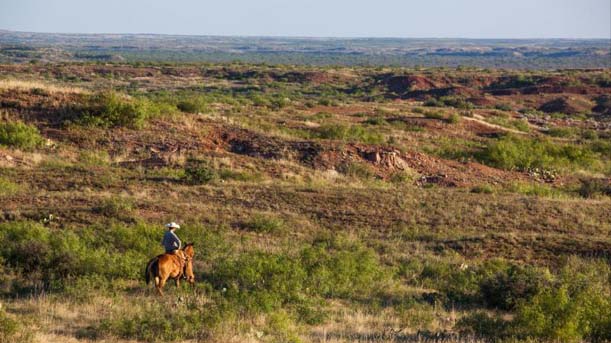
Founded by Dan Waggoner in 1849, his son, famed cattle baron W.T. Waggoner, continued expanding the ranch to the 510,000 acres that will soon be offered to the international marketplace. Owned exclusively by the Waggoner family, this is the first time the 800-square mile estate has ever been listed for sale. The W.T. Waggoner Ranch is the largest contiguous ranch in the United States. Nearly 800 square miles and about the size of Rhode Island, the ranch encompasses six North Texas counties, offering two main compounds, dozens of additional homes, 20 cowboy camps, enormous lakes, hundreds of award-winning quarter horses, thousands of heads of cattle, 1,200 oil wells, and 30,000 acres of cultivated farm land.
 
About Bernard Uechtritz & Sam Middleton
Bernard Uechtritz and Sam Middleton were selected by the families and shareholders of the W.T. Waggoner Ranch Estate by unanimous agreement and confirmed by the receiver and presiding judge in the decision to enter the open market internationally to sell the iconic ranch and its related assets. Sam Middleton is a third generation broker at Chas. S. Middleton & Son of Lubbock, Texas. Bernard Uechtritz is an International Real Estate Advisor for Briggs Freeman Sotheby’s International Realty in Dallas, Texas.
About Briggs Freeman Sotheby’s International Realty
Briggs Freeman Sotheby’s International Realty is the oldest privately held real estate boutique in Dallas. With six offices in Dallas, Lakewood, Uptown, Ranch and Land, The Ballpark and Southlake, and more than 250 associates, the firm specializes in significant properties, from historic to contemporary, ranch to waterfront. The company’s deep-rooted connections, cutting-edge marketing and global strategies bring the extraordinary to all clients. President and CEO Robbie Briggs independently owns and operates Briggs Freeman Sotheby’s International Realty. For more information, visit
Media Contact
For all media requests, information, official photography and any other public relations’ requests, please contact:

Will Beuck, PR Contact

Phone:  cell (214) 802-9506 or office (214) 353-6600
Email address:  waggonerranchsalepr@gmail.com

Continue Reading

Country Lifestyles

The Fence That Changed the West

Published

on

By

Few inventions altered the American landscape as quickly or as permanently as barbed wire. At first glance, it was nothing more than twisted strands of metal with sharp points. But in the 1870s and 1880s, it transformed open prairies into enclosed pastures, reshaped cattle ranching, and set the stage for modern agriculture across Oklahoma, Texas, and the Great Plains.

For generations, settlers and ranchers wrestled with the challenge of fencing the open prairie. Traditional wooden fences required lumber, which was scarce on the plains. Stone walls were impractical across vast tracts of land. Homesteaders needed a boundary that was durable, affordable, and easy to construct.

The solution arrived in 1874, when Joseph Glidden of DeKalb, Illinois, received a patent for his version of barbed wire. He twisted two wires together, anchoring sharp barbs in place so they would not slide. His design proved cheap to produce and easy to stretch across posts. Within just a few years, Glidden’s invention spread like wildfire across the West.

For farmers, barbed wire was liberation. They could protect crops from roaming livestock, keep their own animals contained, and finally bring order to what had been the open range. Small homesteads suddenly had a way to defend their fields from massive cattle herds being driven north to railheads.

But not everyone welcomed the wire. Large cattle outfits, used to driving herds across unfenced land, saw it as a threat. Cowboys called it “the devil’s rope.” Tensions boiled over in the 1880s during the so-called “fence-cutting wars,” particularly in Texas. Cattlemen and farmers clashed as hired hands cut through miles of wire to reopen blocked trails and water sources. Violence erupted in some areas, leading to new laws that punished fence cutting as a felony.

Despite the resistance, the march of barbed wire could not be stopped. Its low cost and effectiveness made it indispensable. By the end of the 19th century, millions of miles of barbed wire crisscrossed the United States, dividing prairies into ranches, farms, and towns.

Once established, barbed wire did more than mark boundaries. It changed the very nature of ranching and agriculture. No longer could cattle roam freely over open ranges; instead, ranchers had to provide feed and water within enclosed pastures. This spurred improvements in breeding, grazing management, and stewardship of land. The great cattle drives that once defined Texas and Oklahoma largely faded, replaced by fenced ranching operations closer to railroads and towns.

The wire also influenced settlement patterns. Homesteads became more secure, encouraging more families to take root on the prairie. Conflicts with Native tribes intensified, as traditional hunting grounds were fenced off. In this sense, barbed wire became a physical symbol of westward expansion—an emblem of progress to some, a barrier to freedom for others.

Culturally, barbed wire has carried layered meaning ever since. Cowboys and poets have written about its sting, while farmers praised its dependability. During World War I, it found new use on battlefields, stretched across trenches as a weapon of defense. In art and literature, it often stands for confinement, conflict, or the taming of wild places.

Even today, the sight of rusty wire strung across weathered posts remains iconic. Drive through Oklahoma or North Texas, and you’ll see it outlining pastures, sometimes still holding cattle, sometimes falling into the grass like a relic of earlier generations. Ranchers continue to rely on barbed wire alongside newer fencing materials, proof that a 150-year-old invention still holds its ground.

The story of barbed wire is not just about technology. It is about how a simple invention shifted the balance between open freedom and private control, between the frontier and settlement. It made agriculture sustainable in places where farming had once seemed impossible. It forced ranchers to rethink livestock management. It even gave rise to laws, conflicts, and a new rhythm of life on the plains.

Like the cowboy hat, barbed wire transcended its original purpose. It became a defining feature of the American West—sharp, unyielding, and practical. It reminds us of the challenges faced by those who carved out lives in Oklahoma, Texas, and across the Great Plains, and how innovation, for better or worse, can change landscapes and livelihoods forever.

References

  • McCallum, Henry. The Wire That Fenced the West. University of Oklahoma Press, 1965.
  • Oklahoma Historical Society. Barbed Wire. https://www.okhistory.org
  • Texas State Historical Association. Barbed Wire and the Fence Cutting Wars. https://www.tshaonline.org
  • Smithsonian Institution. “How Barbed Wire Changed the West.” (2018).
  • Library of Congress. Joseph Glidden and the Invention of Barbed Wire.
Continue Reading

Country Lifestyles

Shifting Gears

Published

on

By

By Alex Haigood

It seems today that the ability to drive a standard transmission is becoming a lost art. In my younger days, if you couldn’t use a clutch, you couldn’t drive. My first three vehicles, two trucks and a car, were all standard transmissions. I would say many young people today have no idea how to drive a car unless it has an automatic transmission.

That probably has a lot to do with the fact that not many stick shifts are made anymore. Everything, even trucks, comes standard with automatic transmissions. There are some sports cars you can still get with a standard, but even those are few and far between.

I knew as a kid that if I wanted to drive and get my license as soon as I could, I would have to learn how to drive a standard. Fortunately, I had a lot of relatives who lived in the country, so I did most of my learning on dirt roads and in the pasture.

I suspect that not many young folks today have any idea what “three on the tree” even means. For the record, that means you had three forward gears, and the gearshift was on the steering column.

I have two memorable stories from my early days of learning to drive a standard. The first was when my dad let me drive a flatbed truck carrying some sheet metal. I popped the clutch a little too fast and almost completely unloaded the truck. We had to back into something to push the material back up on the bed.

The second story involved my uncle, who let me drive while I was on his ranch. I had pulled up to a stop sign on a gravel road that crossed a farm-to-market road. I was stopped on an incline, and my uncle pulled his truck right up behind me. I sat there thinking that when I let off the brake, I was going to start rolling backward into his truck. I sure didn’t want to do that.

So I overcompensated, hit the gas, spun the tires, and threw gravel and dirt all over his truck. All I could see in my rearview mirror was a cloud of dust and dirt. Fortunately for me, he was good-natured and laughed about it. To tell you how long ago that was, he radioed me on his CB and asked if I did that on purpose.

I was fortunate to get to drive early in life in the country and learn the lost art of the standard transmission. Those were fun times. Maybe I need to order me a sports car.

Continue Reading

Country Lifestyles

You Will be Totally Tempted with These New Cupbeas

Published

on

By

By Norman Winter – The Garden Guy

There will be a lot of temptation for gardeners in 2026, so many new plants are showing up at the garden center. Being the astute gardener you are, you probably can guess I am yanking your chain a little as I introduce you to the Totally Tempted cuphea series.

If you are a hummingbird lover you already know some cupheas. The Totally Tempted cupheas come in 4 color or varieties, Richly Red, Watermelon Wine, Frosted Violets and Vivid Violet. They have the potential of reaching 16-inches tall with an 18-inch spread.eas

They are known botanically as Cuphea procumbens with a common name creeping waxweed. Don’t let that name cause any concern. They are native to Southern Mexico and perennial in zones 9 and warmer. They are rock solid, tough and worth every penny as annuals in containers, whether you choose to design a mix or go solo. Your beds will also sizzle with a new artistic touch.

These caught the eye of my good friend, Dr. Allen Owings while at the Young’s Plant Farm Annual Garden Tour in Auburn AL. Allen, formerly a Horticulture Professor at LSU AgCenter is now Horticulturist for Clegg’s Nursery and Bracy’s Nursery. So when he posted the photos on Facebook they caught my attention.

Kim Smith Owner of Smiths Country Gardens in Taylorsville Indiana also went to Facebook. With her trials. She said the violet purple, blush rimmed blooms make it easy to fall in love with Totally Tempted Frosted Violets. Her antique looking urn was filled to overflowing with just Frosted Violets.

She says they are self-cleaning with a continuous blooming habit. She says her zone 5 climate dictates growing as an annual. She recommends plenty of sunlight to keep it from stretching. She went on to say trimming off a little in late July or August can help promote new growth if needed. Kim, feeds weekly with water soluble fertilizer.

Neighbor Dave and his bride Cynthia created a stunning combination in a rectangular concrete planter. They used both Totally Tempted Richly Red and Watermelon Wine with Augusta Lavender heliotrope and Virtuoso Dayglo Yellow dahlia. It is easy for The Garden Guy to peek over the fence and admire.

Son James and the Eden Estate Management team used Totally Tempted Vivid Violet in a window box with Virtuoso Vibrant Violet dahlias. And Supertunia Mini Vista Yellow petunias for a dash of contrasting color.

The Garden Guy went with the Totally Tempted red selections. In the front flower bed at the entrance I used Sunshine Blue II caryopteris with the chartreuse colored foliage. In the backyard I used both Richly Red and Watermelon Wine with the new ColorBlaze Mini Me Chartreuse coleus. In all plantings the flash of red and chartreuse dazzled with color.

Both son James and I found that cutting back kept the plants with a bushier habit. Like Kim Smith recommended, sunlight and frequent fertilization is mandatory. You will find that the Totally Tempted cupheas like others will bring in an assortment of bees, butterflies and hummingbirds. If you will check out Proven Winners Totally Tempted cupheas online you will find recipes for each color, further leading to ……you guessed it, the temptation for the 2025 new plants coming your way. Follow me on Facebook @NormanWinterTheGardenGuy for more photos and garden inspiration.

Continue Reading
Ad
Ad
Ad
Ad

Trending